
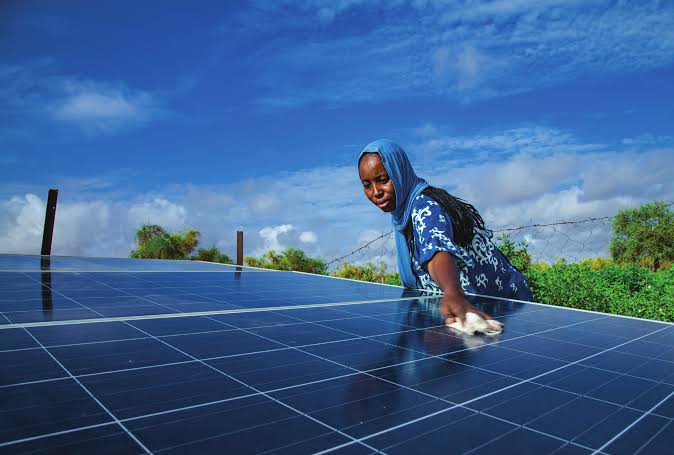
Namu and Nigeria’s push for clean power
Namu, a farming town in Qua’an Pan Local Government Area in Plateau State, Central Nigeria, turned on its new solar mini grid on Wednesday November 12, 2025. The modest array rated at 50 to 100 kilowatts became, for the people who live there, a visible change. Machines that once sat idle in small shops began to hum. Lamps that burned kerosene went dark and electric bulbs came on. The commissioning ceremony was both technical handover and public promise.
Governor Caleb Mutfwang of Plateau State framed the day in simple terms. “Today, Qua’an Pan that once sat in darkness has seen the light,” he said. He described the mini grid as “the beginning of a new journey toward transforming rural economies and empowering local communities.” He linked power to wider state plans, saying the project would work with road repairs and new sources of water to lift local livelihoods.
State authorities, the Rural Electrification Agency, UN development partners and local leaders were all on the dais. The event made clear that the Namu mini grid is not an isolated pilot. It is an early illustration of a national and continental effort to bring renewable electricity to places the main grid will not reach soon.
What was launched
The facility in Namu was developed under the Africa Minigrids Programme or AMP. The programme is funded by the Global Environment Facility and implemented by the United Nations Development Programme in partnership with organisations such as the Rocky Mountain Institute and the African Development Bank. AMP is designed to work in 21 African countries with a dual aim. It helps national governments create policy and regulatory frameworks and it provides technical assistance, knowledge tools and platforms to unlock private investment.
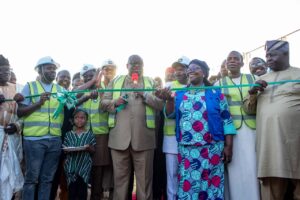
Governor Caleb Mutfwang, UNDP Resident Representative Elsie Attafuah, and other officials during the commissioning of the 50–100 kilowatt solar mini-grid in Namu, Qua’an Pan Local Government Area, Plateau State. Photo: UNDP in Nigeria/X
At the Namu event, Abba Aliyu, Managing Director of the Rural Electrification Agency, set the local installation in national context. He announced a large federal effort in renewable power and described the approval of a 750 million dollar renewable energy programme that aims to deliver electricity to more than 17.5 million Nigerians through more than 1,350 mini grids. He said Plateau State will receive 42 mini grids with ten sited in Qua’an Pan Local Government Area.
“Your Excellency, you have demonstrated visionary leadership and policy foresight,” Aliyu said of the governor and the state reforms that enabled the project. He added that Plateau is “fast emerging as a clean energy hub because of the enabling environment your administration has created through landmark reforms and the establishment of the Plateau State Energy Corporation.”
UNDP Resident Representative Elsie Attafuah said the programme reinforces the idea that climate action and local development can work together. “UNDP reaffirms its commitment to supporting clean energy initiatives as drivers of economic transformation, climate resilience, and peacebuilding in rural communities,” she said.
Local officials spoke for the town. Christopher Manship, chairman of Qua’an Pan Local Government, called the project “a leap from poverty to productivity.” He pledged the community’s readiness to maintain the facility and protect it as a public asset.
Engineers and project managers described the technical and development pathway the grid will follow. Representatives from Cloud Energy Photo Electric and from the AMP team highlighted Namu’s agro economic potential and said the system could expand to serve greater demand. Project managers said the grid could grow from its current 100 kilowatt scale to as much as 2 megawatts if uptake and productive uses increase.
Why mini grids now
Mini grids are rising on policy lists across Africa for practical reasons. They combine falling equipment costs and better batteries with digital tools for billing and payments. They can bring predictable power to towns that are distant from transmission lines in months rather than years.
AMP materials spell out the opportunity plainly. “Renewable energy mini grids, and in particular solar battery mini grids, offer great potential to address the 733 million people globally who currently do not have access to electricity,” the programme text states. It highlights “falling hardware costs, disruptive digital trends and innovative private sector business models” as the chain of developments that make mini grids viable today.
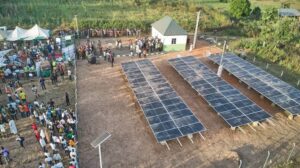
Aerial view of the Namu community in Qua’an Pan Local Government Area, Plateau State. Photo: Government of Plateau State/Facebook
Even so, the AMP documents are candid about the limits. “A key challenge to scaling mini grids is mobilizing private sector investment and accelerating the learning curve for the complex array of stakeholders involved in delivering modern electricity services,” the programme notes. Most current investment takes the form of grants or patient concessional capital. AMP aims to create the enabling conditions for commercial lenders and mainstream investors to enter the market.
For Nigeria the case is sharper. The country’s energy sector remains dominated by oil and gas. Estimates in the public domain place oil and gas as a major part of primary energy supply. At the same time policymakers have set the aim of universal energy access and a long term path to net zero emissions by 2060. That combination creates both urgency and scale for off grid solutions.
The project and the plan
The Namu mini grid sits at the intersection of national targets and local needs. Nigeria’s Energy Transition and Investment Plan sets universal access by 2030 and net zero by 2060 as twin goals. The plan singles out power, transport, cooking and industry as priority sectors that must change. It estimates large investment needs. The plan’s public summary notes that about 410 billion dollars above business as usual will be required and that private sector capital will be fundamental to meeting that gap.
The mini grid programme supports elements of that transition. AMP’s country projects, in line with the programme architecture, work on four pieces. First, they help governments adopt policy and regulation that can clarify licences and tariffs. Second, they promote business model innovation to stimulate private participation. Third, they design financing mechanisms that combine public and private money. Fourth, they support digitalisation and monitoring to build data systems and reduce operational risk.
At Namu, engineers turned on the lights and stakeholders agreed on next steps. Cloud Energy Photo Electric and AMP staff said they will monitor demand, support local entrepreneurs to buy appliances, and test tariffs that cover maintenance while remaining affordable. The goal is to move from donor subsidy to viable local service that can be paid for by households and businesses.
Voices from Namu
The change in the town was visible and immediate. A small cassava processing plant that had been dormant because of unreliable power connected to the mini grid and started operations within days of the commissioning. Residents described the difference in terms of daily life and finance. A shop owner said he can now keep cold drinks for sale and avoid the cost of running a diesel generator.
Officials used the ceremony to press a social case for the system. Governor Mutfwang urged the youth to take advantage of the new platform for enterprise. “Great things begin small, and this project is a symbol of our determination to walk the talk in providing sustainable infrastructure that unlocks rural wealth,” he said.

Women of Namu community celebrating the commissioning of the solar mini-grid, singing, dancing, and clapping in joy. Photo: Plateau State Government/Facebook
Project managers also flagged the durability challenges that will determine whether this model scales. They spoke about training local technicians for operations and maintenance and about creating governance structures so communities can hold operators to account. Those practical arrangements will decide if the Namu grid is replicable.
What the programme promises
AMP is intentionally not a single technology push. Its regional component acts as a knowledge hub. It produces tools for regulators, offers tailored technical assistance for countries, runs communities of practice and supports digitalisation for the sector. AMP’s national projects follow a common architecture that emphasises policy, private sector engagement, innovative finance and data systems.
In plain language the programme tries to reduce risk. It seeks to close policy gaps so developers know how to register and operate mini grids. It tries to create business models that combine household tariffs with productive use of energy in farms and small industry so revenues are steady. It works on financing structures that blend grants and commercial debt to attract banks and institutional investors.
For a country like Nigeria, which needs both large grid scale solutions and local off grid ones, AMP gives a way to test what works in markets that are new and complex.
The wider constraints
The Namu success is not an answer to systemic obstacles. A collection of recent studies and commentary on Nigeria’s energy transition highlights three persistent constraints.
First, financing remains a core problem. “If minigrids are to truly scale, there is a need to access large volumes of commercial financing, and in particular commercial debt,” the AMP text warns. Many developers rely on grants and soft capital because commercial lenders perceive the market as risky.
Second, infrastructure and integration pose limits. Nigeria’s transmission and distribution systems are old and congested. Studies note that the grid cannot always absorb distributed renewable generation. The interface between grid and off grid regulation is still under development. Policymakers and practitioners say that better system planning and clearer rules would reduce uncertainty.
Third, capacity and skills are constrained. The sector needs trained technicians, certified installers and managers who understand battery based systems. A shortage of accredited training and certification raises operational and safety risks.
A technical brief published by development actors and industry commentators summarised these points by listing financing shortages, inadequate infrastructure and weak skills systems as barriers. Those same authors recommend blended finance, stronger regulatory clarity and expanded technical training as steps to address the problems.
How Namu informs policy
Namu provides practical signals for each of those constraints. It shows the kind of local governance arrangements that reduce investor fear. It exposes the demand patterns that shape tariff design. It illustrates how productive uses such as agro processing can make systems more bankable.
Engineers at the launch said a clear next move is to document actual load profiles, appliance uptake and payment behaviour. That data will matter to banks and to policy thinkers who need evidence to justify more commercial financing. AMP’s knowledge management wing will gather that data and try to turn local lessons into national scaleable options.
Elsie Attafuah told the audience that UNDP will support those knowledge processes. “We will continue to work with partners to ensure that lessons from pilots like Namu are captured and shared across countries,” she said. That translates into technical assistance to regulators and tools for developers that can shorten the learning curve.
The stakes for rural economies
The practical case for mini grids moves beyond light bulbs. Energy analysts argue that access to reliable power reshapes local economies by enabling agro processing, cold chain services and digital work. The Namu ceremony put these opportunities on display.
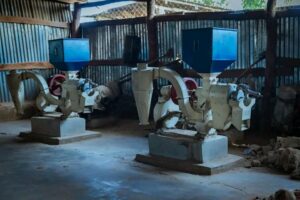
Agro-processing factory in Namu connected to the newly commissioned solar mini-grid, operational and producing local goods. Photo: Plateau State Government/Facebook
Mr. Manship, the local chairman, tied the new supply to immediate economic aims. “This project is a leap from poverty to productivity,” he said. He called on the community to protect the asset and to work with developers to ensure it serves farmers and traders.
Project managers noted that if the grid can reliably power agro processing the local value chain will lengthen. Farmers who now sell raw produce could start drying, milling or packaging goods. Those steps add jobs and increase the return to local agriculture.
What experts say are the remaining challenges and remedies
The AMP documentation and sector studies list the principal challenges and the measures that experts say are needed to scale minigrids. Those documents also include direct recommendations that were cited at Namu and in AMP materials.
“A key challenge to scaling minigrids is mobilizing private sector investment and accelerating the learning curve for the complex array of stakeholders involved in delivering modern electricity services,” AMP materials state. The implication is clear. Governments and development partners must create conditions that reduce risk and improve information.
“If minigrids are to truly scale, there is a need to access large volumes of commercial financing, and in particular commercial debt,” the same programme document says. Practitioners read this as a call for blended finance instruments, guarantees and credit lines that can convert donor capital into leverage for private lenders.
Other analysts have highlighted regulatory gaps. One sector brief summarised the problem in three lines. “Lack of adequate infrastructure and integration,” it said, “limits the potential synergies between grid and off grid sectors. Developing and upgrading the power infrastructure and enhancing grid and off grid integration are essential for ensuring the reliability and efficiency of renewable energy supply.”
Capacity is also a central issue. “Lack of adequate skills and capacity,” reads a recent industry analysis, “is crucial. The sector needs skilled and qualified workers, technicians and engineers who can design, install, operate and maintain renewable energy systems.” Experts at the launch called for accredited training programs and certification schemes that can create a reliable workforce.
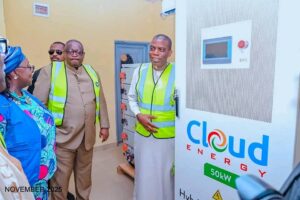
Governor Mutfwang and UNDP Resident Representative Elsie Attafuah inspecting the control room of the solar mini-grid, with Cloud Energy equipment on display, guided by the engineer. Photo: UNDP in Nigeria/X
Those programmatic prescriptions match the pledges made at the commissioning. Officials promised to capture Namu’s operational data, to involve the community in governance, to deliver training for local technicians and to seek financing models that combine public and private money.
Voices repeated
On the day the lights came on, speakers across the platform returned to similar themes. Governor Mutfwang placed the local project within a broader development plan for Qua’an Pan. “What we are witnessing today is not merely the commissioning of a facility, but the birth of a new dream for our people, a dream of light, hope, and shared prosperity,” he said.
Abba Aliyu linked Namu to a national programme of 1,350 mini grids and highlighted the federal commitment. “Plateau is fast emerging as a clean energy hub,” he said, and he welcomed the state’s policy choices.
The UNDP representative emphasised that the project is an example of what inclusive climate resilient development can accomplish. “UNDP reaffirms its commitment to supporting clean energy initiatives as drivers of economic transformation, climate resilience, and peacebuilding in rural communities,” Attafuah said.
Project developers and energy experts at the ceremony reiterated the technical vision. They explained that monitoring demand and enabling productive uses are the immediate tasks. They said the experience in Namu must be turned into evidence that commercial finance can follow.
The next chapter
The Namu grid is small but it is also an experiment in public policy, in private service delivery and in citizen stewardship. Its success sits on a set of practical dependencies. Those include predictable tariffs that cover maintenance, accountable local governance, trained technicians and financing that moves from grant dependency to a blend with commercial capital.
If those parts come together Namu can be a replicable example. If they do not, the lights may go on for a short time and then falter when batteries need replacement or when revenue falls short.
At the ceremony stakeholders promised to take the practical steps. Engineers will collect operating data. Agencies will document the governance arrangements and AMP will fold those lessons into regional knowledge products. That is the sequence AMP designers believe will reduce investor risk.
Challenges and what experts say should be done
Below are the main challenges and expert recommendations recorded in programme materials and in sector briefs that informed the Namu launch.
“A key challenge to scaling minigrids is mobilizing private sector investment and accelerating the learning curve for the complex array of stakeholders involved in delivering modern electricity services,” AMP materials state.
“If minigrids are to truly scale, there is a need to access large volumes of commercial financing, and in particular commercial debt,” the same documents say.
“Lack of adequate financing and incentives” is listed as a prime barrier in industry analyses. Experts recommend blended finance instruments, partial risk guarantees and concessional debt that can be recycled to attract commercial lenders.
“Lack of adequate infrastructure and integration” is another constraint. The remedy experts endorse is coordinated planning between transmission planners and off grid operators, clearer regulatory frameworks for grid arrival and arrangements for asset handover where appropriate.
“Lack of adequate skills and capacity” is the third persistent gap. Experts call for certified training programs, accreditation systems for installers and technicians and accelerated programs to build a local maintenance workforce.
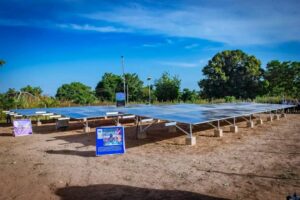
Rows of solar panels installed in Namu, part of the newly commissioned mini-grid supplying clean electricity to the community. Photo: Government of Plateau State/Facebook
Those are not abstract prescriptions. At Namu the practical work begins now. Officials said they would document demand and payment behavior, train local technicians and work with AMP to use the data to access follow on finance. If those steps are carried out and the evidence supports investment, Namu could be the model that unlocks the next wave of mini grids in Plateau State and across Nigeria.
Oil Dependence Still Casts a Long Shadow
Despite the promise of mini‑grids like the one in Namu, many analysts warn that Nigeria’s overall energy transition is constrained by its continued reliance on oil. Orji Ogbonnaya told ICIR that oil and gas revenues still “sustain jobs, government budgets, and energy security,” making a rapid shift to renewables politically and economically difficult.
That dependence also raises risks for long‑term financing. According to Orji, the falling oil demand could destabilize national revenues and hurt Nigeria’s ability to fund clean energy deployment aggressively. Combined with a funding gap of about ₦11.4 trillion for the national transition plan, the pressure is on to channel alternative capital into clean energy.
At the same time, capacity issues remain. BusinessDay reports that foreign investment often comes as concessional capital, but inflation, currency risk, and underdeveloped local technical skills undermine the sustainability of these investments. As a peer‑reviewed study notes, “energy security, which relies on fossil fuel dependency, creates great reluctance toward the shift” away from oil.