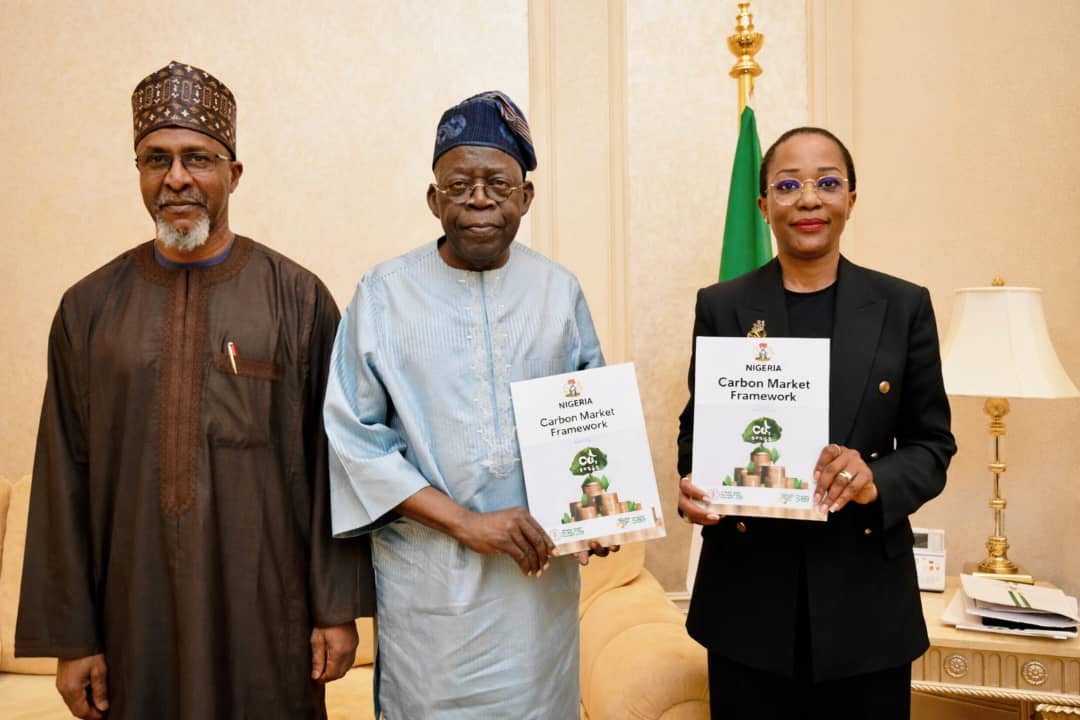
When Nigeria unveiled its long‑awaited Carbon Market Framework in Abu Dhabi this January, the announcement landed far from home but squarely within the global arena where climate finance is being reshaped. The launch took place during Abu Dhabi Sustainability Week, one of the world’s largest annual gatherings focused on clean energy, climate finance, and low‑carbon development, drawing heads of state, investors, multilateral institutions, and climate negotiators from across continents.
For Nigerian officials, the timing and location were deliberate. The framework is intended to signal that Africa’s largest economy is ready to participate more actively in carbon trading, a market increasingly viewed by governments as a way to mobilise private capital for climate action. For investors and climate policy experts, the announcement raised a different set of questions. How will Nigeria govern its carbon market. Can it avoid the credibility problems that have dogged carbon trading globally. And will climate finance reach communities where emission reductions and removals actually occur.
Abu Dhabi Sustainability Week and the climate finance stage
Abu Dhabi Sustainability Week is hosted annually by the United Arab Emirates government and its clean energy company, Masdar. Since its launch in 2008, the event has grown into a major platform where governments announce climate initiatives, corporations showcase clean technologies, and financial institutions court green investments. The 2026 edition brought together political leaders, climate scientists, energy executives, and development banks at a moment when countries are under pressure to accelerate climate action while navigating economic uncertainty.
The week’s agenda focused on energy transition, climate finance, adaptation, and the role of markets in reducing emissions. That context made it a strategic venue for Nigeria to announce its carbon market framework, which the government says will establish the regulatory and institutional architecture for generating, trading, and tracking carbon credits.
In a statement released during the event, the National Council on Climate Change said the framework is designed to “unlock climate finance at scale, strengthen transparency, and position Nigeria as a credible participant in international carbon markets.”
What Nigeria’s Carbon Market Framework sets out to do
The framework is anchored by the National Council on Climate Change, the statutory body established under Nigeria’s Climate Change Act to coordinate national climate policy. According to the council, the framework defines how carbon projects will be approved, how credits will be issued and recorded, and how Nigeria will engage with both compliance and voluntary carbon markets.
Omotenioye Majekodunmi, Director General of the National Council on Climate Change, described the framework as a turning point for Nigeria’s climate finance strategy. In remarks issued by the council, she said the policy sends a clear message that Nigeria is “open for climate business,” adding that carbon trading could attract more than 3.8 billion dollars in annual investment if properly implemented.
The framework identifies sectors where Nigeria expects carbon projects to emerge, including renewable energy, clean cooking, forestry and reforestation, climate‑smart agriculture, waste management, and sustainable infrastructure. It also establishes a national carbon registry, intended to track credits and prevent double counting.
Government officials say these measures are meant to improve investor confidence by providing clarity in a market that has often been criticised for weak oversight.
Carbon markets in global context
Carbon markets allow emission reductions or removals achieved in one place to be quantified and traded as credits. Buyers, which may include governments or companies, use these credits to meet regulatory obligations or voluntary climate commitments.
There are two broad categories. Compliance markets are created through law or regulation, such as emissions trading systems that cap total emissions and allow companies to trade allowances. Voluntary markets operate outside regulatory mandates, with companies or individuals purchasing credits to offset emissions or meet self‑defined climate targets.
Interest in carbon markets has expanded as countries struggle to mobilise the trillions of dollars needed for climate action. The Intergovernmental Panel on Climate Change has estimated that current global climate finance flows are several times lower than what is required by 2030 to limit warming.
According to UNDP, carbon pricing instruments now cover about 28 percent of global emissions and generated more than 100 billion dollars in revenue in 2024. The finalisation of rules under Article 6 of the Paris Agreement has also increased confidence in international carbon trading by setting accounting standards aimed at transparency and environmental integrity.
Nigeria’s ambitions and early signals
Nigeria’s government has framed the carbon market framework as part of a broader effort to align climate action with economic development. President Bola Tinubu has repeatedly emphasised that climate policies must support industrial growth and energy access.
In remarks delivered at Abu Dhabi Sustainability Week, President Bola Tinubu said Nigeria aims to mobilise up to 30 billion dollars annually in climate and green industrial finance. He highlighted reforms in the power sector, including the Electricity Act 2023, which allows decentralised electricity generation and distribution, and referenced Nigeria’s Energy Transition Plan, which targets net‑zero emissions by 2060.
The president also confirmed that Nigeria has adopted a National Carbon Market Activation Policy and launched a National Carbon Registry, steps he said are intended to strengthen transparency and investor confidence.
Officials say interest in Nigeria’s carbon market is already evident. The National Council on Climate Change disclosed that between three thousand and four thousand project applications have been submitted since initial approvals began in October 2025.
Expert perspectives on opportunity
Energy and climate experts have long pointed to Nigeria’s potential to generate carbon credits, particularly through renewable energy and land‑use projects. Reporting by Nairametrics in November 2025 quoted renewable energy consultant, Sunday Okoro as describing solar energy as Nigeria’s fastest route into the carbon economy.
“Every ton of carbon dioxide avoided through solar generation can be quantified and traded as carbon credits,” Okoro said, according to Nairametrics. He added that scaling solar across residential, commercial, and industrial sectors could significantly increase Nigeria’s participation in international carbon markets.
Aisha Bulila, Managing Director of SolarTech Renewables Ltd, told Nairametrics that Nigeria’s high solar irradiation remains underused. She noted that expanding solar capacity could reduce dependence on diesel generators while qualifying projects for carbon revenue.
Policy analysts have also pointed to opportunities in clean cooking, where replacing traditional biomass stoves with cleaner alternatives can deliver measurable emission reductions alongside public health benefits.
Integrity concerns and governance challenges
While the launch has been welcomed as a milestone, experts and international observers continue to raise concerns about carbon market integrity. Globally, voluntary carbon markets have faced scrutiny over low‑quality credits, weak additionality, and projects that fail to deliver promised climate benefits.
UNDP has warned that nearly one billion older carbon credits remain unused worldwide, many associated with projects of questionable environmental value. Flooding markets with such credits can undermine trust and depress prices.
Double counting remains another risk. Without rigorous accounting, the same emission reduction can be claimed by multiple parties, inflating reported progress. Article 6 rules under the Paris Agreement were designed in part to address this issue through corresponding adjustments and transparent registries.
Adaobi Eke, a climate finance consultant quoted by Nairametrics, stressed the importance of robust measurement, reporting, and verification systems. She said buyers are increasingly demanding high‑quality credits backed by credible data and international standards.
“The world is willing to pay for high‑quality credits, but integrity is non‑negotiable,” Eke said, according to the report.
Lessons from other countries
Countries with more mature carbon markets offer lessons for Nigeria. The European Union Emissions Trading System, launched in 2005, has evolved through reforms aimed at tightening caps and stabilising prices. China’s national emissions trading system, now the world’s largest by volume, uses intensity‑based benchmarks and is expanding beyond the power sector.
Brazil finalised its national emissions trading framework in 2024 after years of consultation, positioning itself as a potential leader in Latin America. Other countries, including South Korea, New Zealand, and Switzerland, have implemented or linked trading systems.
These experiences suggest that governance capacity, data quality, and political commitment are critical to market credibility.
Carbon markets and communities
Carbon projects often take place in rural areas where forests, farmlands, or renewable installations are located. Indigenous Peoples and local communities steward many of the ecosystems that store carbon, yet they have historically faced barriers to accessing climate finance.
UNDP has emphasised that well‑designed carbon markets can support community‑led climate action if benefits are shared equitably and safeguards are enforced. Some countries now allocate a portion of carbon revenues to community development or Indigenous funds.
Nigeria’s framework includes provisions for environmental and social safeguards, though details on benefit‑sharing mechanisms are still emerging.
Climate diplomacy and Nigeria–UAE engagement
Nigeria’s carbon market announcement came amid broader climate and trade engagement with the United Arab Emirates. On the sidelines of Abu Dhabi Sustainability Week, Nigeria and the UAE concluded a Comprehensive Economic Partnership Agreement, which Nigerian officials say will deepen cooperation in renewable energy, infrastructure, and climate‑smart development.
Minister of Industry, Trade and Investment Jumoke Oduwole described the agreement as a pathway for attracting quality investment and supporting economic diversification. While the trade deal extends beyond climate, officials have highlighted its relevance for clean energy and sustainable infrastructure financing.
What comes next
The launch of Nigeria’s Carbon Market Framework marks a significant policy step, but implementation will determine its impact. Building credible institutions, enforcing standards, and ensuring transparency will be central to whether Nigeria can attract sustained climate finance.
As global demand shifts toward high‑integrity credits, countries that demonstrate strong governance are likely to benefit most. Nigeria’s experience will be closely watched by investors, civil society groups, and other African countries exploring carbon markets as part of their climate strategies.
For now, the framework places Nigeria firmly within the global carbon conversation. Whether it delivers on its promise will depend on how rules translate into practice, how benefits are distributed, and how rigorously integrity is upheld.