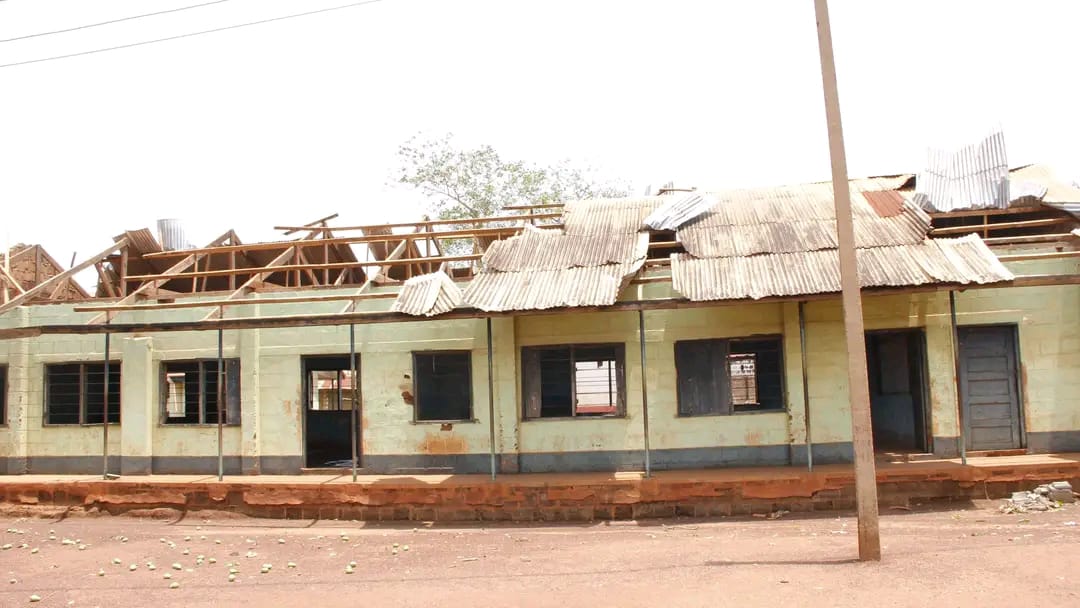
When a violent rainstorm swept through Tom Gangare in Sopp Ward of Riyom Local Government Area of Plateau State on May 30, 2026, residents watched roofs disappear into the sky, walls crumble under falling trees, and entire households lose shelter within minutes.
More than 100 houses were destroyed. Health facilities, places of worship and other community infrastructure were damaged. By the following morning, many families were sleeping in the open, surrounded by the remnants of homes that had stood for years.
“The level of destruction is overwhelming. Many families have lost their homes and mean of livelihood,” community stakeholder Dung Danboyi said while appealing for emergency assistance.
The disaster in Riyom was not an isolated event.
Across Northern Nigeria, windstorms and rainstorms have increasingly left behind a trail of damaged homes, destroyed schools, displaced families and, in some cases, loss of life. From Plateau to Benue, Taraba, Kwara, Yobe and Bauchi, communities are confronting a pattern that scientists, emergency agencies and climate researchers say demands closer attention.
The growing frequency of these incidents is raising questions about climate vulnerability, environmental degradation, urban expansion and the preparedness of communities facing increasingly severe weather events.
A Week of Destruction Across States
The same period that left hundreds homeless in Plateau State also brought tragedy to Obi Local Government Area of Benue State.
According to reports published on May 30, 2026, a devastating windstorm accompanied by heavy rainfall swept through several communities in Obi LGA, damaging homes, businesses and public infrastructure.
The worst-hit area was reportedly Obarike community along the Ogore axis, where a restaurant owner died after a large tree fell on her during the storm.
Residents said homes, business premises and roads suffered extensive damage.
“The windstorm was one of the most severe natural disasters witnessed in the LGA in recent times,” Obi Local Government Chairman Silas Ahunye said after visiting affected communities, according to a statement by his media aide, Emmanuel Ekpe.
The chairman appealed to the Benue State Emergency Management Agency (SEMA), humanitarian organisations and other stakeholders for urgent support.
The incident echoed a similar disaster that struck Otukpo, Benue State, in March 2026.
As reported by Premium Times, students at Jesus College returned to school for terminal examinations on March 17 only to find classrooms, laboratories, staff quarters and examination halls devastated by a windstorm that occurred days earlier.
“The windstorm blew down almost everything in the school. Staff quarters, classrooms, the staff room, and the exam hall. Virtually everything was affected,” the school’s principal, Simon Omala, told Premium Times.
At least 12 classrooms reportedly lost their roofs, while rainwater damaged ICT equipment and other educational facilities.
The destruction raised concerns about the ability of students, including those preparing for the West African Senior School Certificate Examination (WASSCE), to continue learning under safe conditions.
Plateau’s Repeated Encounters with Windstorms
For communities in Plateau State, the Riyom disaster represents the latest chapter in a series of destructive weather events.
On April 3, 2025, Blueprint reported that a rainstorm damaged more than 70 houses and barns in Mabudi, Sabon Gida and neighbouring communities in Langtang South Local Government Area.
Residents said roofs were torn off homes and several structures collapsed.
A resident, Nanbol Nanzing, appealed for government intervention after the storm left many households struggling to recover.
The chairman of Langtang South Local Government, Nanfa Nbin, later confirmed the incident through a statement issued by his media aide.
The recurrence of such events in Plateau is becoming a concern for local authorities and disaster management agencies, particularly as settlements expand into areas increasingly exposed to severe weather.
From Taraba to Kwara, Storms Leave a Trail of Losses
The impacts extend well beyond Plateau and Benue.
In Bali Local Government Area of Taraba State, a severe windstorm in June 2025 killed at least six people and injured 30 others.
Residents told Daily Trust that schools, mosques, churches, shops and homes were destroyed, while food supplies worth millions of naira were lost.
“The windstorm was very devastating and the worst recorded in recent years in the area,” resident Abubakar Dodo told the newspaper.
The disaster affected more than 300 households, prompting intervention from the North-East Development Commission (NEDC), which later assessed the damage and promised support for affected residents.
Less than a year later, another storm struck Taraba.
In April 2026, the United Methodist Church Nigeria Episcopal Area announced that a severe windstorm had destroyed the church building of the United Methodist Church in Garu Gutumbur, located in Didango District.
According to a statement signed by Reverend Filibus Bakari Auta, Director of Communications for the church, more than 300 worshippers were left without a place of worship after the structure was completely damaged.
Meanwhile, in Kwara State, storms have repeatedly exposed the vulnerability of schools and residential communities.
In March 2025, a violent windstorm destroyed more than 200 houses and several public schools across Ilorin and communities in Asa Local Government Area.
According to reports by PUNCH and SaharaReporters, roofs were ripped off school buildings, classrooms collapsed and electricity infrastructure was damaged, plunging communities into darkness.
“The destruction is huge. This has resulted in many residents becoming homeless suddenly,” community leader Zubairu Abiola told journalists while appealing for state intervention.
Yobe’s Annual Reality
In Yobe State, windstorms have become an almost annual occurrence.
According to Daily Trust, the Yobe State Emergency Management Agency reported that flooding, heavy rainfall and windstorms affected more than 31,000 households in 2022, killing 72 people and injuring 200 others across the state.
The situation has continued.
In 2024 alone, Yobe authorities said windstorms and rainfall displaced more than 10,800 people and destroyed over 14,000 rooms in 47 communities across 12 local government areas.
Executive Secretary of the Yobe State Emergency Management Agency, Goje Muhammad, said the disaster caused widespread destruction, including the loss of lives.
For many residents, environmental degradation is becoming impossible to ignore.
“It wasn’t like this 20 years ago because there were enough trees which covered almost all parts of the state,” Ibrahim Jibrin, Ward Head of Jijigogazai in Nangere Local Government Area, told Daily Trust.
Climate change expert Ahmed Muhammad Abubakar attributed part of the challenge to desertification and the loss of natural wind barriers.
“We are in a frontline state where our rainy season is characterised by windstorms, dunes and dust,” he said. “These strong winds normally need shelterbelts that will reduce their velocity so that they do not cause disruptions in settlements.”
What the Research Says
Scientists are increasingly examining the factors behind the growing impacts of weather and climate-related extreme events in Nigeria.
A 2025 study published in the journal Heliyon by researchers Kamil Muhammad Kafi and Zakiah Ponrahono examined how spatial planning, community practices and local environmental conditions influence exposure to windstorms in Bauchi State.
The researchers surveyed residents in nine communities frequently affected by extreme weather events.
According to the study, respondents largely identified climate change and local human activities as major drivers of worsening weather-related disasters.
The study found that increasing rainfall variability, rapid urbanisation, weak development control, settlement expansion into hazard-prone areas and poor environmental management were contributing to heightened exposure.
The authors noted that many neighbourhoods in Bauchi have expanded into gullies, waterways and environmentally vulnerable areas, increasing the risk of damage when storms occur.
“Climate change is perceived as the primary culprit,” the researchers wrote, adding that residents also linked worsening impacts to local human activities and weaknesses in urban planning.
The study concluded that disaster risk reduction strategies should integrate spatial planning, policy reforms and community participation.
Urban Growth and Ecological Vulnerability
The relationship between environmental change and growing disaster risks is not limited to human settlements.
A recent commentary published by Mongabay and written by Nigerian ornithologist Bello Adamu Danmallam highlighted how rapid urbanisation is transforming ecosystems across Africa.
Drawing on research published in Frontiers in Conservation Science, the study analysed citizen science data from bird monitoring projects in Kenya and Nigeria.
The findings showed that urban expansion reduces biodiversity and weakens ecological functions performed by birds.
“As urbanization has intensified, the variety of bird species and their roles in the ecosystem shrinks, resulting in more uniform communities with generalist species,” Danmallam wrote.
The commentary noted that urban land cover in Africa is projected to triple by 2030, increasing pressure on habitats and ecological systems that help maintain environmental resilience.
While the study focused on biodiversity, researchers argued that poorly planned urban growth can intensify environmental vulnerabilities and weaken natural systems that support healthy ecosystems.
The Human Cost Behind the Statistics
Behind every damaged roof and collapsed wall are families forced to rebuild lives after sudden disaster.
In Riyom, residents continue to seek assistance months after losing homes and livelihoods.
In Otukpo, students sat examinations in damaged classrooms.
In Taraba, survivors recounted watching schools, churches and businesses collapse under violent winds.
In Yobe, families described a cycle of repairing homes only to face similar destruction during the next rainy season.
Across affected communities, emergency management agencies often arrive after disasters occur. Yet the recurring pattern is increasingly shifting attention toward prevention rather than response alone.
A Growing Test for Policy and Planning
The repeated destruction across Northern Nigeria highlights the intersection of climate risks, settlement patterns, infrastructure vulnerability and environmental management.
Research findings from Bauchi suggest that stronger development controls, risk-informed urban planning and community-level preparedness could reduce exposure to future disasters.
Environmental experts have also pointed to the role of ecosystem restoration, including tree planting and shelterbelt development in vulnerable regions, particularly in areas experiencing desertification and land degradation.
For policymakers, the challenge extends beyond emergency relief.
As communities from Plateau to Benue, Taraba, Kwara and Yobe confront recurring windstorms and extreme rainfall, the broader question is how Nigeria can strengthen resilience before the next storm arrives.
The answer may lie in combining climate adaptation, environmental restoration, disaster-risk planning and infrastructure standards into a coordinated response capable of protecting both people and the landscapes on which they depend.