When the Nigerian government announced on October 12, 2025, that it had granted a state pardon to the Ogoni Nine, it was seen by many observers as a symbolic step toward correcting one of the most painful injustices of the 1990s. But for Amnesty International, the gesture was not enough. The global rights organisation insisted that Nigeria must go further by fully exonerating the men who were executed in 1995 after what Amnesty described as a “flawed judicial process that did not meet even the basic standards of fairness.”
Today, almost three decades after the death of writer and environmental activist Ken Saro Wiwa and eight others, Amnesty International is renewing its call for accountability. In a detailed briefing shared publicly, the organisation argues that the world must not look away from unresolved questions concerning the role of Shell in the human rights violations that engulfed Ogoniland during the military rule of the 1990s.
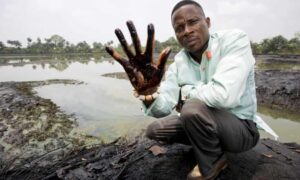
This image shows Eric Dooh, a Nigerian farmer and activist who became the lead plaintiff in a landmark lawsuit against Shell over oil spills in the Niger Delta. The photo depicts him holding up his hand covered in crude oil from a creek near his former home, the village of Goi, in Ogoniland, Nigeria. Photo: The Guardian
“We have repeatedly called for the full exoneration of the Ogoni Nine because the trial was a sham and the executions were an outrage,” Amnesty International said in its renewed statement. “There must also be meaningful accountability for the actions of Shell and for the conduct of the Nigerian state during that period.”
This renewed push comes at a time when the Niger Delta continues to suffer the fallout of decades of oil extraction. Even as Shell prepares to sell its onshore assets, communities say the legacy of pollution, displacement and violence cannot be erased with a shift in ownership.
A Long Shadow Over Nigeria’s Energy Story
The Niger Delta has long been the heart of Nigeria’s oil economy. Shell, still remembered locally as Shell BP, began commercial operations in the region in the 1950s. By the early 1990s, Shell was producing close to one million barrels of crude oil per day, which was roughly half of Nigeria’s national output at the time. Oil revenue supplied more than 90 percent of the country’s foreign exchange earnings.
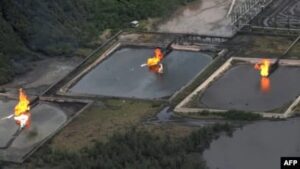
A gas flare at Shell Cawtharine Channel, Nembe Creek in the Niger Delta, July 10, 2015. Photo: AFP
The scale of this dependence is documented in multiple internal communications from the company. In one memo cited by Amnesty International, Shell executives described the joint venture between the company and the Nigerian National Petroleum Corporation as “inextricably entangled with state interests.”
It was against this backdrop that the Movement for the Survival of the Ogoni People, MOSOP, emerged. MOSOP accused Shell of polluting Ogoni farmlands, streams and air with decades of oil spills and continuous gas flaring. In January 1993, the group issued its Ogoni Bill of Rights and declared that Shell was no longer welcome in the community. The company withdrew its staff but continued to send contractors into the region to work on a new pipeline.
The United Nations Environment Programme, UNEP, would later publish a landmark report in 2011 confirming that pollution in Ogoniland had reached levels that were, in the words of the African Commission on Human and Peoples Rights, “humanly unacceptable.” UNEP described contamination that had penetrated groundwater to depths of up to five meters. It found benzene levels in some drinking water supplies that were up to 900 times the safe limit.
The seeds of conflict had been planted long before the fatal events of 1994 and 1995.
A Cycle of Protest and Repression
Tensions escalated quickly in 1993 as Shell attempted to resume operations with the support of armed security forces. Amnesty International’s investigation draws heavily on independent witness accounts and internal company documents to reconstruct this period.
On 30 April 1993, soldiers deployed to protect Shell contractors opened fire on unarmed protestors in Biara. Eleven people were seriously injured. Days later in Nonwa, troops shot and killed a protestor during another confrontation. According to Amnesty International, Shell was aware that the use of force by security agencies was predictable and highly likely.
The organisation cites a Shell internal memo describing a meeting with senior police and intelligence officials held in May 1993. The memo states that Shell “expressed appreciation for efforts” by the agencies and discussed “logistical support for planned deployments.” Amnesty says the document reflects the company’s preference for state intervention over community engagement.
Shell has always denied encouraging violence. The company maintains that it only made “legitimate requests for protection” and that it was “never complicit” in human rights violations. But Amnesty International argues that these denials do not adequately address questions raised by Shell’s own internal records and witness testimony gathered over three decades.
The Rise of the Internal Security Task Force
By 1994, the Rivers State Internal Security Task Force, ISTF, became the dominant security formation in Ogoniland. The unit was commanded by Major Paul Okuntimo. Amnesty International cites a confidential memo attributed to Okuntimo that recommended a “ruthless military operation” to “restore order” and facilitate economic activity in the region. While Shell and the Nigerian government have both questioned the authenticity of this memo, the operations that followed closely mirrored its language.
Amnesty International reports that ISTF raids destroyed villages, burned homes and forced thousands of people to flee their communities. An Amnesty researcher who visited Ogoniland in late 1994 described the situation as a “military siege” in which residents lived “in fear of night raids, arbitrary arrests and sexual violence.”
The Dutch ambassador to Nigeria, in a cable made public years later, reportedly told Shell officials that as many as 800 Ogoni people had been killed in the unrest. Amnesty International says this diplomatic communication is part of the wider body of evidence that shows the scale of abuses.
Shell’s Interactions with the Military Government
One of the strongest claims in Amnesty International’s renewed briefing concerns Shell’s contact with senior government figures. Amnesty cites minutes of meetings in which Shell executives discussed the “Ogoni problem” with the military leadership, including General Sani Abacha.
Shell acknowledges that it met officials regularly, as required of any major joint venture partner, but denies urging the government to suppress protests.
However, Amnesty points to a November 1995 record in which General Abacha expressed “satisfaction” to Shell executives after the confirmation of a major gas project that Shell was negotiating with the Nigerian state. Amnesty argues that this reinforces the perception that the company maintained a close and mutually beneficial relationship with the military administration even at the height of the repression in Ogoniland.
The organisation also highlights testimony from former security officers who said Shell provided transport, boats, food supplies and sometimes cash to support security operations. Shell has admitted that it provided logistical support in some cases but insists this was normal practice in remote areas and that the company had no control over how security forces used the support.
The Arrest and Execution of the Ogoni Nine
The pivotal moment came on 21 May 1994 when Ken Saro Wiwa and several MOSOP leaders were arrested and accused of involvement in the murder of four Ogoni chiefs. Amnesty International, Human Rights Watch and numerous governments condemned the arrest as politically motivated.
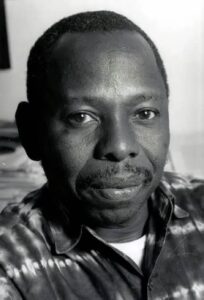
Late Kenule Beeson Saro-Wiwa was a Nigerian writer, television producer, and environmental and social rights activist, best known for leading the Movement for the Survival of the Ogoni People (MOSOP). He campaigned against the environmental damage caused by oil companies in the Niger Delta and advocated for the rights of the Ogoni people. He was executed by the military dictatorship in 1995, a death that provoked widespread international outrage and led to Nigeria’s suspension from the Commonwealth. Photo: Open Country Mag
Amnesty quotes one eyewitness who said soldiers “went from house to house dragging people out and beating them” as part of the security sweep following the arrests.
The trial that followed is widely considered one of the most discredited in Nigeria’s legal history. In its renewed statement, Amnesty says the tribunal “failed to meet the most basic international standards” and that witnesses “later recanted their evidence, saying they were bribed and threatened.”
Shell has always insisted that it had “no hand in the arrest, trial or execution” of the men. But Amnesty International argues that the company should have used its influence to urge restraint more forcefully and more publicly.
“We have found no evidence that Shell made any meaningful effort to intervene,” Amnesty said. “Instead, the company continued to prioritise its commercial negotiations with the military government.”
The Ogoni Nine were executed on 10 November 1995. Global outrage was immediate. Nigeria was suspended from the Commonwealth. Sanctions followed.
The executions hardened the determination of Ogoni communities to seek justice.
A Fight That Has Never Ended
Today, cases linked to decades of oil pollution in the Niger Delta continue to appear in courts in Europe and Nigeria. In 2021, the United Kingdom Supreme Court ruled that two communities, Ogale and Bille, could sue Shell in London for environmental damage. In its judgment, the court said the claims raised “arguable issues” about Shell’s responsibility.
Shell, meanwhile, maintains that it has improved its environmental standards and continues to deny any role in human rights abuses.
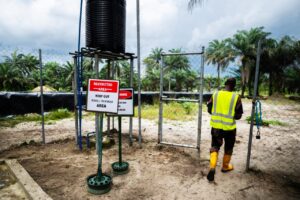
25.10.2024, Nigeria, K-dere Documentation of the environmental impact of oil spills made for Amnesty Nigeria. Subject: oil extraction in the Ogale & K-dere communities and the effects of oil spills on people’s livelihoods, resources and work. Looking for visible impacts on agriculture, water sources, sanitation. Photo: Amnesty International
But Amnesty International says the facts remain stark. “Pollution has devastated the lives of over thirty million people in the Niger Delta,” the organisation said. “Communities have been left to drink contaminated water, farm on destroyed land and breathe toxic air.”
The UNEP report from 2011 found that a full clean up of Ogoniland would take up to 30 years. More than a decade later, progress has been slow and often contested.
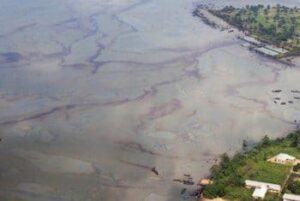
An aerial view of Ogoniland shows oil floating on the water’s surface, August 7, 2017. Photo: UNEP
For many Ogoni families, justice still feels distant.
A Renewed Call in the Present
Amnesty International’s renewed demand for accountability is not only about revisiting the past. It is a warning about the future. As Nigeria explores new frontiers in gas production and debates the transition to renewable energy, the unresolved story of Ogoniland stands as a reminder of what happens when communities are excluded from decisions about their land and resources.
“The exoneration of the Ogoni Nine is essential,” Amnesty said. “But justice also requires a full investigation into the role played by Shell and by state actors. Without this, the truth remains incomplete.”
For Nigeria, the story is more than a footnote in the history of military rule. It is a test of whether the country can confront past abuses, protect environmental defenders and guarantee that the mistakes of the 1990s are never repeated.
The Path Forward
As Amnesty International intensifies its campaign, several questions continue to shape the national and global conversation. Will the Nigerian government formally exonerate the Ogoni Nine as families demand? Will international regulators launch deeper investigations into Shell’s past conduct? And will the long promised clean up of Ogoniland finally accelerate?
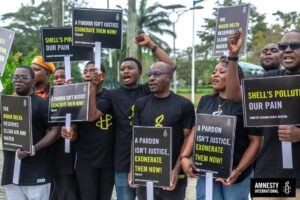
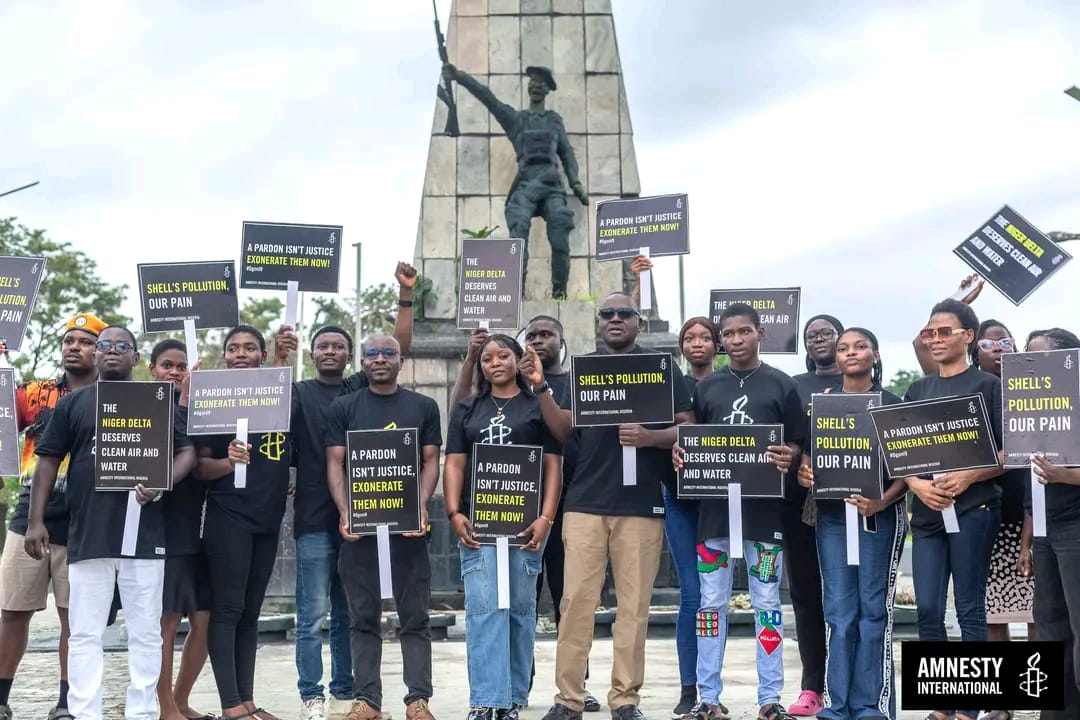
A small crowd of Amnesty International staff and activists stand together at Isaac Boro Park on 10 November 2025. Photo: Amnesty International Nigeria/Facebook
In Ogoni communities, hope is cautious but still alive. Many residents say that even if justice comes late, it must still come.
The struggle that began in 1993 has not ended. It has only changed form. And as Amnesty International pushes the world to remember, Nigeria is once again confronted with the unresolved legacy of oil, power and human rights.