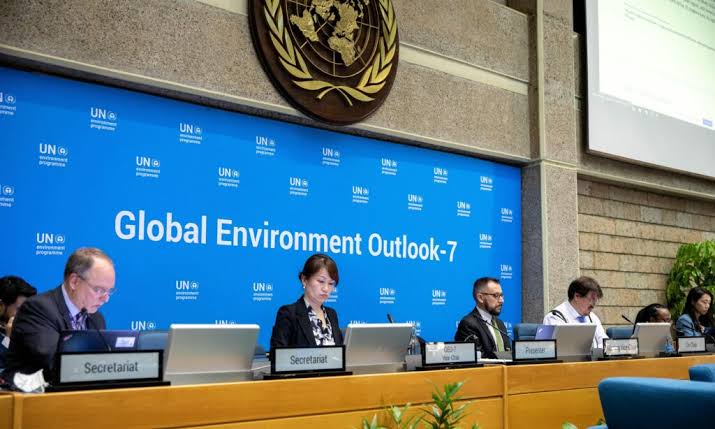
The latest Global Environment Outlook offers a stark warning and a lucrative roadmap, projecting that transformative climate action could yield benefits worth over 25 percent of global GDP by 2100, but the window for the world to act is closing fast.
In a sweeping and urgent assessment, the United Nations has declared that the planet has entered uncharted territory, facing interconnected crises of climate change, biodiversity collapse, land degradation, and pollution that are already reversing socioeconomic gains and undermining global security. However, embedded within this stark warning is a powerful economic argument: choosing to invest in transformative action now could unlock annual benefits exceeding one hundred trillion dollars by the end of the century. The seventh Global Environment Outlook, titled A future we choose: Why investing in Earth now can lead to a trillion dollar benefit for all, concludes that most internationally agreed environmental goals are on track to be missed with current policies. It presents a framework not merely for survival, but for a managed transition that could redefine global development, offering a path to resilient infrastructure, sustainable jobs, and food security while avoiding the worst economic damages of unchecked environmental decline.
The economic benefits of action exceed the costs of transformation, as the damages from the global environmental crises will become increasingly severe over the coming decades, the report states. It projects that the overall macroeconomic annual benefits of systemic transformation are estimated to begin around 2050 and increase to approximately twenty trillion dollars per year by 2070, and over one hundred trillion dollars per year by 2100, accounting for more than 25 percent of projected global GDP in 2100. This assessment underscores a critical juncture for every nation, emphasizing that the crises are no longer simply environmental issues. They are also economic, development, governance, security, social, moral, and ethical issues.
A Worsening Planetary Emergency with Global Consequences
The GEO 7 report, a synthesis of scientific evidence from across the globe, paints a dire picture of accelerating breakdowns. It warns that the rate of global warming is likely higher than previous central estimates, increasing the risk of irreversibly passing several climate tipping points within the next few decades. These include catastrophic shifts like major changes in ocean circulation, accelerated ice sheet loss, widespread permafrost thaw, and the collapse of coral reef ecosystems. Beyond climate, the foundations of natural life are eroding. One million of an estimated eight million species are threatened with extinction, and between twenty and forty percent of the world’s land area was estimated to be degraded in 2022, with an area the size of Ethiopia or Colombia lost annually between 2015 and 2019.
The report’s executive summary is blunt about the failure of current trajectories. Most of the internationally agreed environmental goals and targets are unlikely to be met with existing policies and practices, it states. This includes the Paris Agreement’s goals, with current projections pointing to a devastating temperature rise of 2.4 to 3.9 degrees Celsius above pre industrial levels this century, falling well short of the goal to limit warming to 1.5 degrees. The root cause, the analysis finds, is unsustainable systems driven by increasingly resource intensive lifestyles, especially in high income countries, met by environmentally unsustainable production and consumption within economic and governance systems unfit to meet these challenges sustainably. These environmental crises are causing substantial economic and social damage, including to infrastructure, transport, and basic services, harming jobs, livelihoods, economic growth and security, and undermining human health and wellbeing, food, energy and water security for all people, with disadvantaged populations being disproportionally affected.
A Narrowing Window for Systemic Transformation
Yet, the GEO 7 insists transformative pathways are still possible. The GEO 7 scenario analysis shows that internationally agreed environmental goals can still be achieved, but will require unprecedented action, the summary states. This action must be at a scale and pace never before seen, combining whole of government and whole of society approaches. There is a rapidly narrowing window of opportunities to successfully embrace and implement the solutions needed to transform the systems, the report warns, calling on governments, intergovernmental organizations, the private sector, financial institutions, academia and civil society to co produce policies, develop technology, provide financing, and accelerate institutional and cultural changes at an unprecedented level of integration and depth.
The report’s core argument is that piecemeal solutions are futile. Instead, it calls for the simultaneous transformation of five interconnected systems: economic and financial, materials and waste, energy, food, and environmental management. Transformation of the economic and financial systems is a prerequisite for transforming the other systems, the report states. This involves phasing out and repurposing environmentally harmful subsidies, estimated at about 1.5 trillion dollars per year from energy, food and mining, and internalizing social and environmental externalities into the prices of goods and services, an unaccounted cost of about forty five trillion dollars per year from energy and food systems alone. It also requires moving beyond traditional measures of economic activity like GDP by including natural capital and human wellbeing in decision making and aligning financial flows with international environmental goals.
A Blueprint for Overhauling Energy, Food, and Waste Systems
For the materials and waste system, the report advocates implementing a global circular economy. This means designing out waste from production and consumption, shifting investments to deliver circularity, developing effective markets for secondary materials, and fostering an inclusive societal transformation towards sustainable lifestyles. This can significantly reduce waste generation and the economic losses, the report notes. It can also help avoid significant increases in extractive activities for critical energy transition minerals, offering clear environmental co benefits and addressing other issues, including the global plastic pollution crisis.
Transforming the global energy system requires a multifaceted approach that simultaneously addresses energy access and poverty, the report states. Key actions include diversifying energy production, including increasing use of renewable energy technologies while simultaneously accelerating the phasing out of unabated fossil fuels, electrifying final energy services in transport, industry, housing and agriculture, and ensuring the sustainability of critical energy transition minerals. Similarly, transforming the food system requires a shift to healthy and sustainable diets, adopting more sustainable and resilient food production practices, reducing food losses and waste, and reforming markets to incentivize environmentally responsible practices.
Improved management of the environment system for sustainability and resilience requires protecting, conserving and restoring ecosystems and biodiversity, in conjunction with sustainable land management practices, the report adds. It emphasizes embracing the widescale implementation of nature-based solutions and adopting adaptive governance to safeguard the rights, access and benefits of Indigenous Peoples over their traditional lands and draw on their knowledge. Indigenous Peoples and local communities’ knowledge, values, and ways of being contribute to transformations towards sustainable and just futures, the report states, noting they offer concepts of human nature relations based on ethics of care.
Tailored Pathways and a Call for Equity
The report stresses that solutions cannot be uniform. The design of solution pathways should be tailored for the socioeconomic ecological context of each region, it advises, noting that the most severe consequences are experienced by the most vulnerable and disadvantaged populations. It outlines differentiated responsibilities, stating that high income countries can more easily adopt ambitious green policies, reduce resource consumption, acknowledge the principle of common but differentiated responsibility, halt the export of negative environmental impacts, and leverage global sustainability through finance and technological capacity. Middle income countries can embrace innovative infrastructure development and green policies, while low income countries can overcome challenges such as hunger and poverty, improve livelihoods, build climate resilient communities and infrastructure, while reducing emissions by leapfrogging outdated technologies and leveraging targeted investments and international support.
The United Nations Environment Programme’s report ultimately frames a historic decision. One path leads to escalating, interconnected crises that will drain economies, amplify inequalities, and destabilize societies. The other requires an unprecedented, coordinated overhaul of how humanity produces, consumes, and governs, a daunting task presented as the only viable choice with staggering economic and social returns. Achieving environmental goals, alongside social and economic benefits, requires a whole of government and whole of society approach, the report concludes, a call for global unity and decisive action in the face of a rapidly narrowing window. The trillion-dollar question is whether the world will choose to make the necessary investments before it closes.
This feature is based on the Executive Summary of the Global Environment Outlook 7: A future we choose – Why investing in Earth now can lead to a trillion-dollar benefit for all, published by the United Nations Environment Programme in 2025. Direct quotes are sourced from this publication. The full report is available from UNEP.