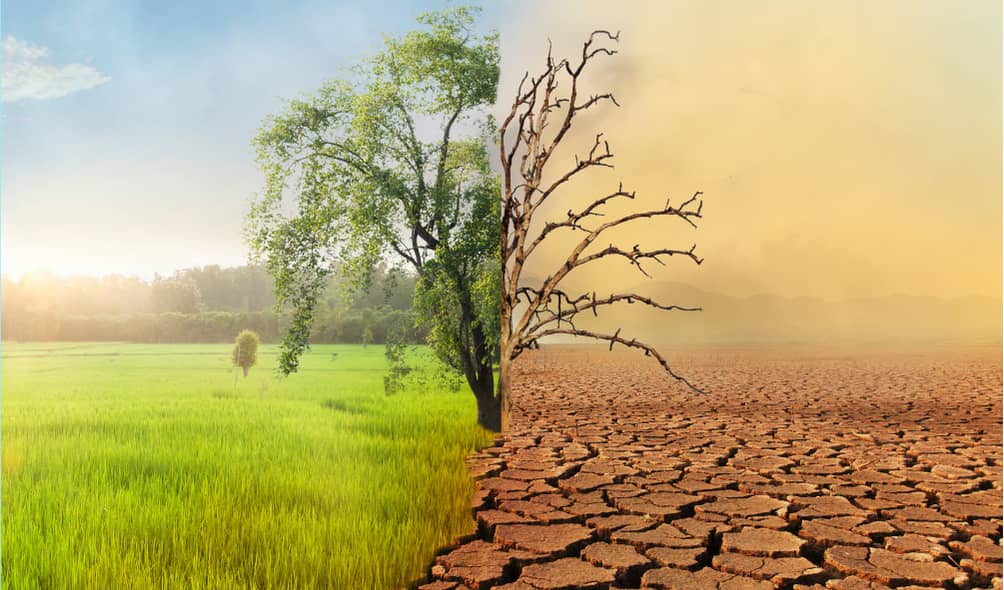
An image showing the Earth divided between a thriving green landscape and a dry, cracked wasteland, symbolizing the stark contrast between life and destruction caused by climate change. Cr: Google
What Is Climate Change
Climate change refers to long-term changes in temperature, rainfall, and weather patterns. While natural factors such as solar activity and volcanic eruptions can influence the Earth’s climate, the main driver since the 1800s has been human activity. The burning of fossil fuels like coal, oil, and gas releases greenhouse gases that trap heat in the atmosphere, causing the planet to warm.
The most significant of these gases—carbon dioxide and methane—come from everyday activities such as driving cars, generating electricity, cutting down forests, and industrial production. Together, these emissions form a blanket around the Earth, heating the planet and disturbing the natural balance of ecosystems.
A Warming Planet
Scientists have found that human activity is responsible for almost all the global heating of the past two centuries. The Earth’s surface is now about 1.4°C warmer than it was before the Industrial Revolution and hotter than at any time in the last 100,000 years. Each of the past four decades has been warmer than the one before it.
This rise in temperature triggers other disruptions. Melting ice caps, severe droughts, floods, wildfires, and ocean level rise are all connected. Climate change does not only mean heat—it reshapes weather systems, food supplies, and water sources.
Global Inequality
Climate change affects everyone, but not equally. Low-income nations, especially small island states and developing countries, bear the worst impacts despite contributing the least to the problem. Sea level rise, saltwater intrusion, and prolonged drought have already displaced communities and deepened poverty in vulnerable regions.
In contrast, six major emitters—China, the United States, India, the European Union, Russia, and Brazil—account for more than half of global greenhouse gas emissions. The 45 least developed countries together contribute only about 3 percent. This imbalance underscores the need for stronger climate justice and international cooperation.
Why Every Degree Matters
Scientific assessments show that limiting global warming to no more than 1.5°C would help avoid the most dangerous consequences of climate change. Yet, current global policies could lead to as much as 3.1°C of warming by 2100. Every fraction of a degree matters—because each increment worsens extreme weather, food insecurity, and displacement.
Solutions and Commitments
The solutions are known and achievable. Transitioning to renewable energy, protecting forests, adopting sustainable farming, and investing in resilient infrastructure all reduce emissions while strengthening economies. The Paris Agreement and the Sustainable Development Goals provide a shared framework for these efforts.
But time is critical. To keep warming below 1.5°C, global emissions must fall by half before 2030 and reach net zero by 2050. This requires reducing the production and use of fossil fuels by at least 30 percent this decade.
Nigeria’s Climate Reality
In Nigeria, the effects of climate change are already visible. The Nigeria Meteorological Agency (NiMet) has recorded rising temperatures and irregular rainfall patterns over the past sixty years, contributing to frequent floods and prolonged droughts. These shifts threaten rain-fed agriculture, which sustains much of the population and accounts for about 23 percent of the nation’s Gross Domestic Product.
Warmer conditions also create favourable environments for diseases such as malaria. Beyond health and food, climate stress is intensifying insecurity across the country, especially in the Middle Belt, where shrinking resources have heightened conflict between farmers and herders.
The Cost of Inaction
If Nigeria fails to act decisively, these impacts could reverse years of development gains. Climate change threatens progress on poverty reduction, education, and economic growth, and could derail national efforts to achieve the Sustainable Development Goals. As Mohamed Yahya, Resident Representative of the United Nations Development Programme (UNDP) Nigeria, warns, the nation risks losing its development momentum without urgent adaptation and mitigation.
Nigeria’s Pledge
Nigeria ratified the Paris Agreement in 2015 and has outlined its Nationally Determined Contributions (NDCs), which detail efforts to cut emissions and adapt to climate impacts. Full implementation of the NDCs could reduce emissions by up to 50 percent while maintaining steady economic growth of about five percent annually by 2030.
The UNDP and other partners are supporting Nigeria through programmes aimed at increasing climate ambition, accelerating action, and mobilizing financial resources. Leadership at every level—government, business, and community—is essential to translate these commitments into results.
Financing the Transition
Climate action requires substantial investment, but the cost of inaction is far greater. Developed nations have a responsibility to support developing countries like Nigeria with funding and technology to move toward green, resilient economies. Local innovation and private sector participation will also be key to sustaining this transition.
Nigeria Climate Watch’s Mission
Founded in 2025, Nigeria Climate Watch is a non-profit, non-partisan newsroom dedicated to reporting on the climate crisis in Nigeria. We produce essential journalism, investigations, and analysis on the nation’s most pressing environmental challenges.
Our work holds government, corporations, and institutions accountable for their policies and actions. We expose environmental injustice, counter misinformation, and examine both the causes and solutions to climate change, with a focus on transparency, justice, and public interest.
Nigeria Climate Watch: Independent newsroom reporting on climate change, environmental justice, and accountability across Nigeria.