A Night Interception in the Creeks
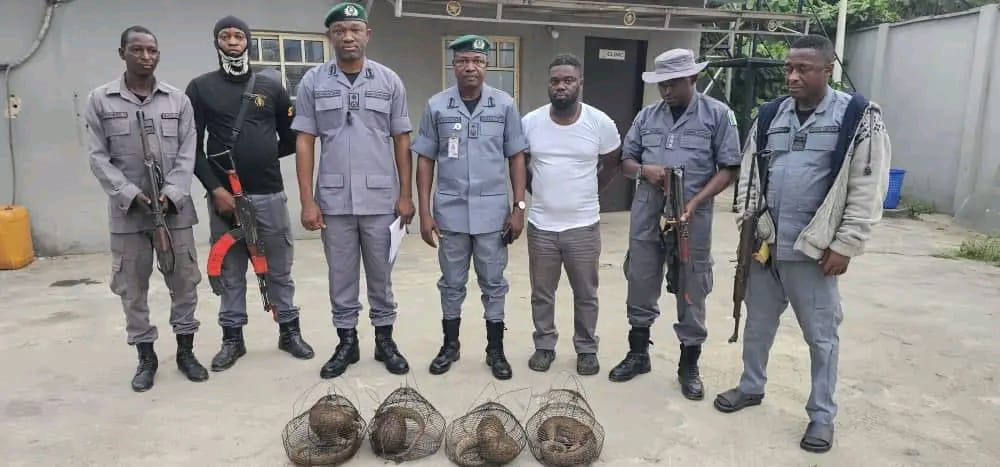
Just after nightfall on 15 January 2026, operatives of the Federal Operations Unit Zone A of the Nigeria Customs Service were patrolling the narrow waterways around Ajilete, a quiet creek community in Ogun State. Acting on intelligence, the officers stopped a wooden boat moving through Alapa Creek. Inside were four live pangolins, crammed into wire mesh cages.
The suspected traffickers did not wait to be questioned. According to Customs, they jumped into the creeks and disappeared, abandoning both the boat and the animals.
The interception was announced days later in a statement signed by the unit’s public relations officer, Chief Superintendent of Customs Hussaini Abdullahi. The pangolins, all endangered, were handed over to the Wildlife Conservation Centre for care. For Customs officials, it was another small but symbolic victory in a fight that has long defined Nigeria’s uneasy place in the global wildlife trade.
“This interception reflects the professionalism, courage and commitment of our officers,” said the Comptroller of FOU Zone A, Gambo Aliyu, commending the patrol team. He urged officers to remain vigilant, especially during night operations, and reaffirmed the unit’s resolve to enforce wildlife protection laws in collaboration with other agencies.
On its own, four rescued pangolins might seem minor. In context, it is anything but.
Pangolins and a Global Market
Pangolins are the most trafficked mammals in the world. Their scales are prized in parts of Asia for traditional medicine, despite having no proven medical value. Their meat is considered a delicacy in some markets. Across Africa, pangolins have been hunted to near extinction, not only for local consumption but for export through organised criminal networks.
Nigeria sits at the centre of this trade.
In its World Wildlife Crime Report 2020, the United Nations Office on Drugs and Crime described Nigeria as “a primary transit hub” for illicit wildlife products, including pangolin scales and ivory, moving from Central and East Africa to Asia. Porous borders, busy ports, weak enforcement, and corruption combined to make the country a preferred route.
That reputation has been hard to shake.
Between 2015 and 2019, UNODC data showed that Nigeria accounted for more than a quarter of all ivory seizures worldwide, despite hosting a tiny fraction of the global elephant population. A 2021 study estimated that pangolin scales seized in shipments linked to Nigeria over a decade came from nearly 800,000 individual animals.
The Ajilete seizure sits within that grim arithmetic.
A Pattern, Not an Isolated Case
The Customs interception in Ogun State echoes larger seizures made in recent years. In August 2025, Nigeria Customs announced what it described as the country’s largest wildlife-trafficking bust by number. More than 1,600 live birds, including ring-necked parrots and canaries, were intercepted at Lagos International Airport, bound for Kuwait.
“It is the largest seizure by number,” Customs spokesperson Abdullahi Maiwada told BBC News at the time. He added that most trafficked animals from Nigeria are destined for Asia.
That case, like many before it, exposed how wildlife trafficking exploits routine trade routes. The birds lacked proper documentation, even though some species were common. Investigations were launched, and the animals were transferred to the National Parks Service for rehabilitation.
According to BirdLife International, the illegal wildlife trade globally generates between $7 billion and $23 billion each year. Nigeria is not the largest source of wildlife, but it has been one of the most important corridors.
“Wildlife trafficking is frequent,” Maiwada said. “Nigeria’s porous borders and weak enforcement have made it a key transit hub.”
From “Toothless Dog” to Active Enforcer
For years, Nigeria’s Customs Service struggled to counter that image. In a 2024 reflection published by the World Customs Organization, Abim Isafiade, Team Manager of the Special Wildlife Office of the Nigeria Customs Service, described the pre-2021 era bluntly.
“Nigeria appeared to many to be a ‘toothless dog’, all bark and no bite,” he wrote, noting that despite widespread trafficking, no one had ever been convicted for wildlife crimes.
That has changed.
Since 2021, Customs has prosecuted and secured convictions against 13 individuals for wildlife trafficking, with at least 50 more cases ongoing as of October 2024. Officers have seized more than 20 tonnes of pangolin scales, alongside ivory, rhino horn, and other protected species.
Isafiade attributed the shift to structural reform, including the creation of the Special Wildlife Office in 2021. The unit coordinates trained officers, works with international partners, and applies intelligence-led methods such as risk profiling, controlled deliveries, and forensic analysis.
“We have changed the narrative and have become the new sheriff in town,” he wrote.
The Ajilete interception reflects that change. It shows Customs operating not only at airports and seaports, but also in creeks and rural waterways that traffickers increasingly use to evade scrutiny.
Enforcement Meets the Law
Yet enforcement alone has never been enough. For decades, Nigeria relied on the Endangered Species Act of 1985, a law conservationist widely regarded as obsolete. Penalties were weak, prosecutions rare, and jurisdictional overlaps allowed suspects to slip through cracks.
That legal gap is now narrowing.
In 2024, the National Assembly passed the Endangered Species Conservation and Protection Bill, Nigeria’s most ambitious wildlife law to date. The bill strengthens penalties, allowing for prison terms of up to ten years or fines reaching ₦12 million, or both. It expands investigative powers, enabling authorities to track financial flows, seize assets, and prioritise wildlife cases in court.
“This Bill sends an unambiguously clear message that Nigeria will not tolerate the use of its borders for trafficking illegal wildlife products,” said Terseer Ugbor, deputy chairman of the House Committee on Environment, during legislative debates.
Nigeria Climate Watch previously described the bill as “a turning point for biodiversity and climate protection”, arguing that it modernises Nigeria’s response to environmental crime and aligns domestic law with global agreements such as the Convention on International Trade in Endangered Species of Wild Fauna and Flora.
The Ajilete case, though small, illustrates why that legal shift matters. Without strong penalties and swift prosecution, seizures risk becoming routine interruptions rather than deterrents.
Why Wildlife Crime Is a Climate Story
Wildlife trafficking is often framed as a conservation issue. Increasingly, experts argue it is also a climate issue.
Pangolins play a critical ecological role. By feeding on ants and termites, they regulate insect populations that can otherwise damage forests. Elephants disperse seeds and maintain forest structure. When such species disappear, ecosystems lose resilience.
The UN Environment Programme has warned that environmental crime, including wildlife trafficking, “directly undermines ecosystem integrity and climate action”. Degraded ecosystems store less carbon, recover poorly from shocks, and increase vulnerability to floods and drought.
Nigeria knows these consequences well. Deforestation and land-use change account for a significant share of the country’s greenhouse gas emissions. Forests stripped of wildlife regenerate more slowly, weakening natural carbon sinks.
“When we lose wildlife, we lose the very balance that protects our farms, forests, and rivers,” Ugbor said in an interview with Reuters. “This is about protecting not only animals but the systems that sustain our people.”
Inside the Networks
One reason wildlife trafficking persists is its deep entanglement with organised crime. UNODC officials have long warned that the trade mirrors narcotics trafficking in structure and reach.
“Nigeria has evolved into a primary transit hub,” UNODC said in its World Wildlife Crime Report, noting that products arrive from other African countries before being shipped onward.
Oliver Stolpe, UNODC’s Country Representative for Nigeria, has argued that impunity is a key driver. “It has become absolutely critical that the legal community is aware of the key issues related to the illegal wildlife trade,” he said at a UNODC roundtable in Abuja. “Without decisive action, these crimes will continue.”
That concern has driven new collaborations. UNODC, working with the National Judicial Institute, Environmental Investigation Agency, and Africa Nature Investors Foundation, has trained judges, prosecutors, and investigators on wildlife crime. The aim is to ensure that cases do not collapse for lack of understanding or procedural delays.
At one such roundtable, judges admitted they had rarely encountered wildlife cases, highlighting how underreported and under-prosecuted the crime has been.
Progress, With Limits
There is no question that Nigeria’s response has improved. In August 2024, Customs, working with the Wildlife Justice Commission, seized nearly 9.5 tonnes of pangolin scales in coordinated operations in Kano and Lagos. Four suspects were arrested and charged.
According to a senior analyst cited by the World Customs Organization, these arrests have caused “considerable levels of turmoil and disruption” within Nigerian and Vietnamese trafficking networks, altering how criminal groups view Nigeria.
Still, experts caution against optimism without sustained investment.
Traffickers adapt quickly. As airports and ports become riskier, creeks like those in Ajilete gain importance. As penalties increase in one jurisdiction, routes shift to another.
“If Nigeria acts alone, traffickers will simply reroute through weaker borders,” warned a report by the Wildlife Justice Commission. Regional cooperation, intelligence sharing, and consistent prosecution remain essential.
From Seizure to Systemic Change
The four pangolins rescued in Ogun State will likely survive. Many others will not.
For Nigeria, the significance of the Ajilete interception lies less in numbers than in narrative. It is a reminder that wildlife crime is not an abstract global problem but a local one, unfolding in creeks, markets, ports, and courtrooms.
It also underscores a fragile transition. Nigeria is moving from being cited primarily as a problem country in international reports to positioning itself as an active enforcer with modern laws and trained officers.
Whether that transition holds will depend on what happens after interceptions. Do investigations lead to arrests. Do arrests lead to convictions. Do convictions deter future crime.
For now, the creeks remain contested ground. But each seizure, however small, tests whether Nigeria’s new resolve is real or rhetorical.
The pangolins of Ajilete are unlikely to know the difference. The law, at last, might.