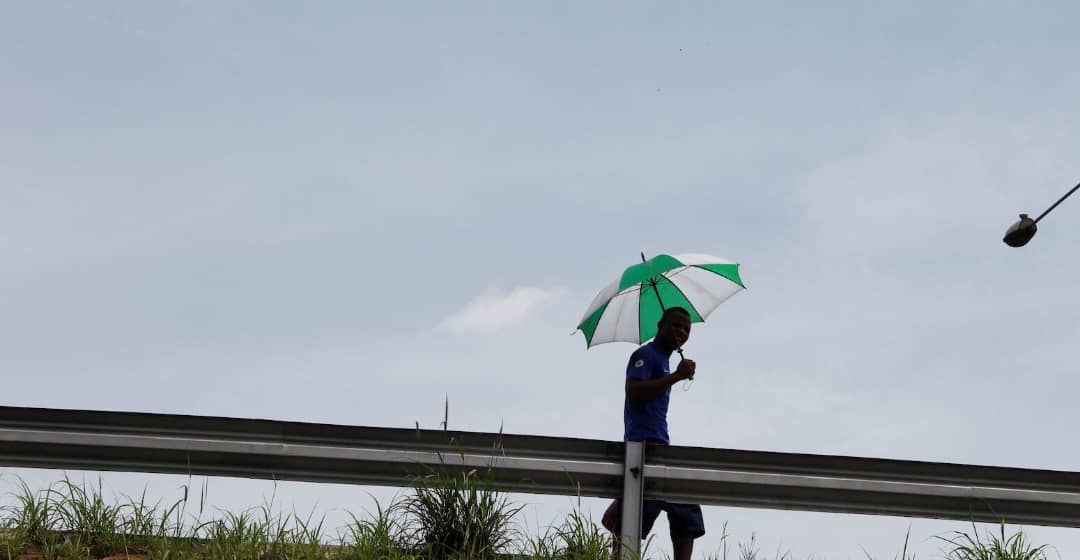

A man walks along a highway barrier under the scorching sun, shielding himself with a green and white umbrella during a heatwave.
Photo credit: Carbon Brief
When the temperature in Sokoto peaked at 47°C earlier this year, hospitals saw a surge in patients fainting from dehydration. Farmers abandoned fields by mid-morning. In Kano and Maiduguri, workers began adjusting their routines, starting earlier and closing before noon. Across Nigeria, unbearable heat is no longer an occasional discomfort. It has become a public health emergency and a test of national resilience.
A country getting hotter, faster
Nigeria is heating up at an alarming rate. Meteorological records show average temperatures have risen by about 1.6°C since 1901, and projections indicate a possible 3°C increase by the end of this century if global emissions remain unchecked. While this might appear modest, it means more frequent and longer-lasting heatwaves—conditions once rare are now recurring almost every dry season.
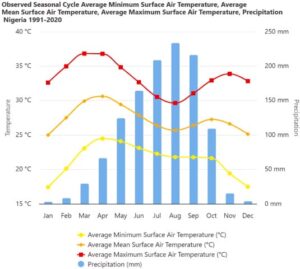
The average mean surface air Temperature and precipitation of Nigeria Between (1991) and 2020 (Graphic Credit: Albós, 2025).
The Nigerian Meteorological Agency (NiMet) warns that extreme heat days have tripled since the early 2000s. In the North Central region, where open farmlands and sparse vegetation dominate, the rise is particularly harsh. Urban areas such as Abuja and Lagos are also struggling under the “urban heat island” effect, were asphalt and concrete trap warmth, making cities hotter than surrounding rural zones.
Human cost of rising heat
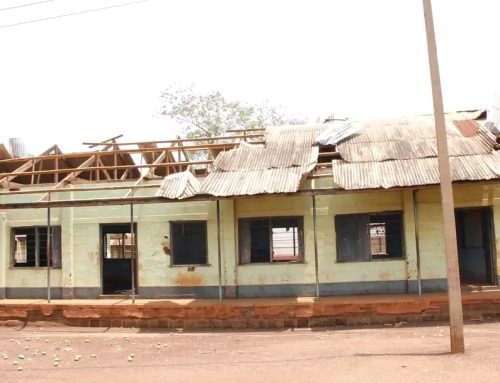
The first to feel the pain are outdoor workers. Construction labourers, farmers, traders, and transporters endure long hours under direct sunlight. The Ministry of Health reports an uptick in heat-related illnesses such as stroke, fainting, and respiratory distress. In 2024 alone, several state hospitals in Katsina and Sokoto recorded dozens of heatstroke admissions, mostly among elderly people and children.
“People think heat just makes you sweat,” says Dr. Hadiza Ibrahim, a public health physician in Kano. “But prolonged exposure can shut down the body’s ability to cool itself. We are seeing more deaths from dehydration, kidney stress, and underlying heart conditions.”
Beyond health, extreme heat is draining productivity. Farmers report lower yields of maize, sorghum, and rice due to soil moisture loss. Herdsmen struggle to find water sources for livestock as ponds and rivers dry faster. In parts of Benue and Nasarawa, residents now spend more on fuel and electricity to power fans or pump water.
Cities under strain
Urban Nigeria is becoming a heat trap. In Lagos, average night temperatures now hover above 30°C, denying residents the relief once found after sunset. Power shortages compound the misery, leaving millions without cooling options. For those who can afford air conditioning, energy demand spikes, further straining an already fragile electricity grid.
Environmental planners blame unregulated construction, poor urban forestry, and declining green spaces. Lagos alone has lost nearly 40 percent of its urban vegetation in the last two decades, according to satellite analysis. “Trees are our cheapest cooling system,” says urban planner, Sola Adesina. “But we keep replacing them with glass and concrete.”
Economic and agricultural toll
Nigeria’s agricultural backbone is wilting under heat stress. Studies by the International Institute of Tropical Agriculture (IITA) predict crop losses of up to 20 percent in northern states if current temperature trends continue. Heat reduces pollination rates, increases pest infestation, and speeds up evaporation.
The livestock sector faces similar threats. Heat-stressed animals eat less and produce less milk or meat. Farmers in Adamawa and Taraba report early deaths among goats and cattle during peak dry seasons. The economic ripple spreads to markets, raising food prices and deepening poverty in rural households already on the brink.
Climate science behind the heat
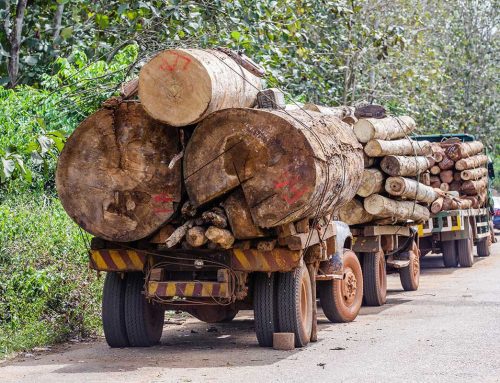
Scientists attribute Nigeria’s rising temperatures to a combination of global warming and local environmental degradation. Deforestation, driven by logging and firewood demand, strips away the natural canopy that regulates surface temperature. Unchecked gas flaring in the Niger Delta releases vast quantities of greenhouse gases, while rapid urbanisation amplifies heat accumulation.
“Every tonne of carbon we emit today locks in more heat for tomorrow,” notes Dr. Peter Eze, a climate scientist at the University of Abuja. “Nigeria may not be a top emitter globally, but the local consequences are severe because of weak adaptation systems.”
Government response: still a gap
Nigeria has adopted several frameworks, including the National Adaptation Plan and the National Climate Change Policy (2021–2030). Yet implementation remains slow. Few states have local climate action plans or heat adaptation strategies. Early warning systems for extreme weather are limited, and public awareness is low.
In some states, pilot projects are emerging. Katsina has begun community tree planting campaigns, while Lagos is testing reflective roofing materials in informal settlements. But these efforts are fragmented. Without coordinated national funding and enforcement, experts fear the heat crisis could overwhelm existing systems.
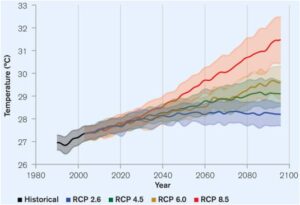
Projected average Temperature for Nigeria (Graphic Credit: Dove, 2021).
The path forward
To adapt, experts recommend heat-resilient infrastructure, sustainable urban planning, and public education on heat safety. Expanding green belts in cities, promoting climate-smart agriculture, and enforcing emission limits on industries could slow the trend.
The broader challenge is governance. As Nigeria commits to its Nationally Determined Contribution under the Paris Agreement, real progress will depend on integrating climate adaptation into everyday decision-making—from housing and transport to energy and food production.
“Heat is invisible, but its damage is real,” says environmental policy analyst, Jumoke Olawale. “We can no longer treat it as a seasonal inconvenience. It’s a structural threat to health, economy, and survival.”
A warming warning
The silent rise in temperature is already redrawing Nigeria’s environmental map. Rivers are shrinking, harvests are shrinking, tempers are rising. Every degree added means more lives at risk and more livelihoods in peril. The country’s next test is not just how it endures the heat, but how it transforms its systems to live through it.