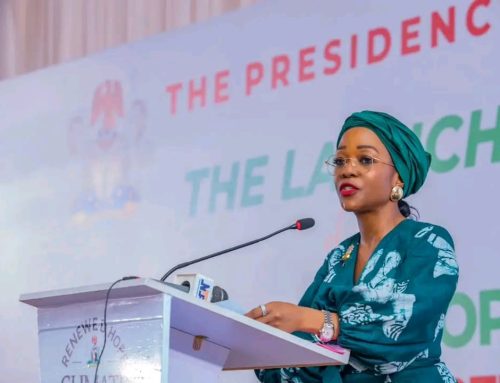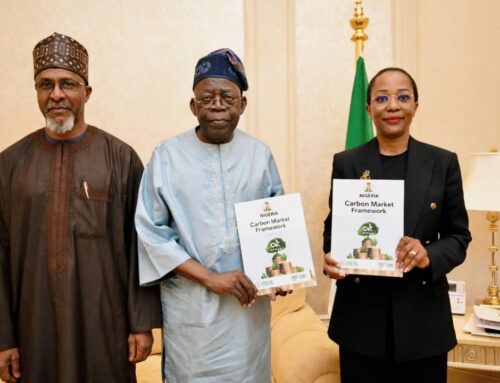
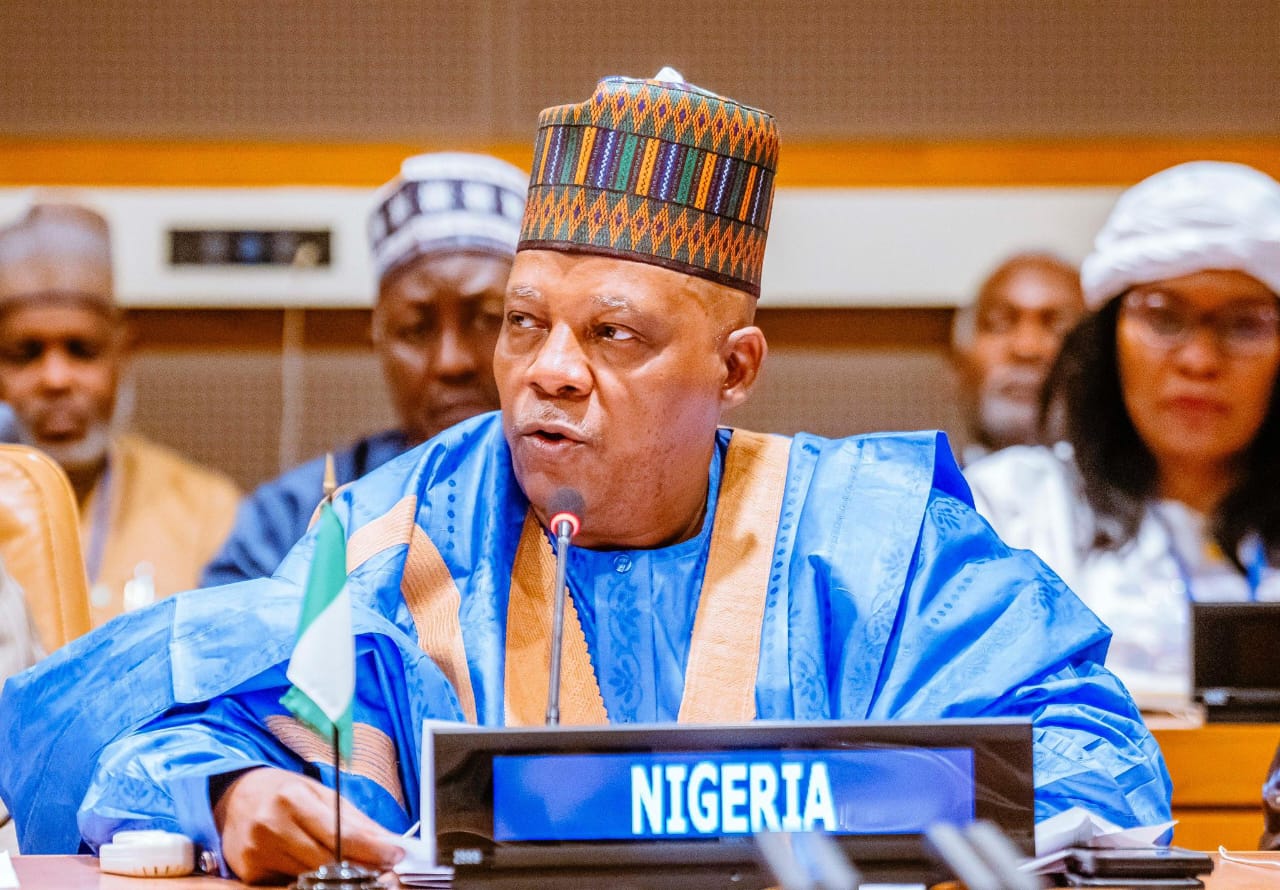
Vice President Kashim Shettima annoucing Nigeria’s National Determined Contributions (NDCs) during the 80th UN General Assembly 2025. Photo Credit: UN
By Nigeria Climate Watch
When Nigeria’s Vice President, Kashim Shettima, stepped to the podium at the United Nations General Assembly in New York, his message was clear: Africa’s largest economy is resetting its climate ambition. The unveiling of Nigeria’s third Nationally Determined Contribution (NDC 3.0) marked not only another update to a Paris Agreement commitment but a test of whether intent can finally meet implementation.
For a country that contributes less than one percent of global greenhouse gas emissions yet ranks among the ten most vulnerable to climate shocks, this latest climate blueprint arrives at a decisive moment. Behind the numbers lies a simple question: can Nigeria match words with measurable action?
From Paper to Policy
Nigeria’s NDC 3.0 targets a 29 percent reduction in greenhouse gas emissions by 2030 and 32 percent by 2035, relative to 2018 levels, with a long-term goal of net-zero emissions by 2060.
The plan envisions phasing out routine gas flaring within five years, transforming half of the national power mix to renewables, and ensuring that one in three vehicles on Nigerian roads runs on electricity by 2035. It also promises to cut deforestation by 60 percent, plant 20 million trees annually, and reduce open waste burning by 40 percent.
On adaptation, the government commits to flood control infrastructure, climate-smart agriculture, and resilient urban planning. For the first time, health sits at the centre of Nigeria’s climate response, with plans to electrify 44 tertiary hospitals and build 2,000 climate-resilient primary healthcare facilities by 2030.
These are ambitious steps. Yet their success depends on whether the policies that follow can move beyond declaration to durable enforcement.
A Plan Built by Thousands
According to the Federal Ministry of Environment, the new NDC is Nigeria’s most inclusive climate document to date. Over 50,000 Nigerians—from academics and civil society to women, youth, and all 36 state governments—participated in shaping it, supported by the UN Development Programme and other partners.
This wide engagement reflects a shift from elite policymaking toward public ownership of climate action. But inclusiveness alone will not guarantee impact. Nigeria’s previous NDCs also carried bold promises that faltered under weak institutional coordination, inconsistent data, and limited finance.
Where Vulnerability Speaks Louder Than Numbers
The stakes are visible across Nigeria’s six geopolitical zones.
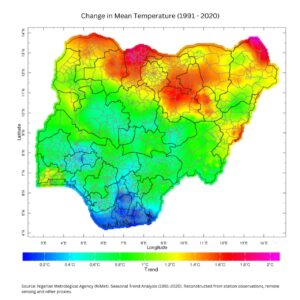
Between 1991 and 2020, Nigeria has witnessed changes in the mean temperature
Source: Nigeria Metrological Agency
In the northwest, the drying of rivers around Kebbi and Sokoto has pushed farmers to abandon traditional crops, while advancing desertification forces pastoralists to travel further in search of pasture—often triggering resource conflicts.
In the northeast, Lake Chad has shrunk by about 90 percent since the 1960s. Generations who once fished and farmed now face food insecurity and displacement. In Borno and Yobe, youth who once depended on the lake’s economy have turned to risky migration or joined local militias for survival.
In the north-central region, including Benue State—the country’s food basket—unpredictable rainfall and recurrent floods have erased entire harvests. Farmers speak of replanting two or three times each season, only to lose everything to rising waters. The NDC’s emphasis on climate-resilient agriculture and river-basin flood management could transform such communities, but only if local execution matches national ambition.
Down south, the picture shifts but remains equally grim. Along the Lagos lagoon, sea-level rise and rapid urbanisation have made flooding an annual disaster. Informal settlements such as Makoko stand at the frontline of climate-induced displacement. In the southeast, expanding gully erosion continues to swallow homes, schools, and farmlands—sometimes overnight.
Across these regions, climate change is no longer an environmental issue; it is a survival issue.
The Just Transition Promise
Nigeria’s NDC 3.0 aligns with the global consensus reached at COP28 on a “just transition”—the principle that climate action must not leave behind the poor and marginalised. In Nigeria’s context, this means cushioning workers in the fossil-fuel sector, safeguarding smallholder farmers, and ensuring new green investments create jobs rather than displacement.
The document pledges fairness and equity, but experts caution that translating this into governance frameworks will require clarity on what “just” means in policy and budget terms. Without this, communities already suffering the brunt of climate impacts risk becoming afterthoughts in the transition to cleaner energy.
The Financing Hurdle
Nigeria estimates it will need US$337 billion between 2026 and 2035 to deliver its NDC 3.0 targets. Public finance alone cannot carry that burden. The government is working with partners, including UNDP, to develop a financing framework aimed at attracting international climate funds, private investment, and domestic capital.
However, previous climate finance mechanisms have struggled with transparency and accountability. Analysts warn that without clear tracking systems; funds risk being diverted from critical adaptation priorities—such as rural electrification and community-based resilience programmes—toward high-profile but low-impact projects.
Dr. Femi Adebajo, an environmental economist based in Abuja, describes this as “the paradox of ambition without architecture.” In his words, “Nigeria’s targets are technically sound. The challenge lies in creating a financial and governance system that makes implementation traceable and corruption resistant.”
The Accountability Gap
The release of NDC 3.0 coincides with the development of Nigeria’s new National Development Plan (2026–2030), which seeks to build a $1 trillion economy under the Renewed Hope Agenda. How these two frameworks align—or clash—will determine whether Nigeria’s climate ambitions become integral to national planning or remain on paper.
Policy analysts point to three recurring problems: weak inter-ministerial coordination, overlapping mandates between the Ministry of Environment and energy regulators, and the absence of a clear monitoring system at the subnational level.
States and local governments, often the first responders to climate crises, rarely have the technical or financial capacity to execute adaptation projects. Without stronger decentralisation, the NDC’s promise of inclusivity will ring hollow.
Beyond Declarations
Nigeria’s climate story mirrors a global tension: the gap between political declaration and practical change. Yet it also carries an undercurrent of opportunity.
If the NDC 3.0 triggers credible enforcement of gas flaring bans, investment in renewables, and integration of climate risk into development planning, the results could reshape Nigeria’s energy economy and restore degraded ecosystems.
But if implementation stalls, the consequences will be stark—deeper food insecurity, displacement, and loss of public trust in climate governance.
Samuel Tordue, a farmer in Guma, Benue State, put it plainly: “Every year, they talk of new plans. But when the rain comes, the river still rises and we start again.”
His words echo across the country—a reminder that while climate policy begins in conference halls, its success or failure is measured in the fields, markets, and coastlines where Nigerians live daily with its consequences.
A Test of Resolve
The next decade will decide whether Nigeria’s climate ambitions evolve into genuine transformation. The goals are clear, the frameworks exist, and the science is urgent. What remains is the political and institutional will to make it real.
As the world counts down to 2035, Nigeria’s NDC 3.0 stands as both a statement of hope and a mirror of accountability. The nation has declared its intent. Now, the measure of its resolve will lie in the lives it protects—and the future it builds.