
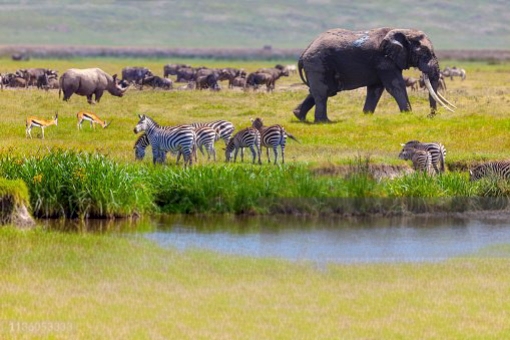
Africa’s biodiversity and the communities that depend on its face growing pressure from the systems driving global nature loss, according to a new report by the World Wide Fund for Nature (WWF), which calls for urgent action to transform food production, energy use and financial investment.
The Living Planet Report 2026: The Science of Hope warns that the world is losing biodiversity at an unprecedented rate, threatening the ecosystems that support food production, freshwater supplies, climate regulation and economic activity.
The report cites the Living Planet Index, which tracks changes in monitored populations of mammals, birds, fish, reptiles and amphibians. It found that these populations declined by an average of 73 per cent between 1970 and 2022.
Although the figure represents a global average and does not mean that 73 per cent of all wildlife has disappeared, it reflects a substantial decline in the size of monitored vertebrate populations.
The report identifies agriculture, fossil fuel use and financial investment in environmentally damaging activities as major drivers of biodiversity loss. It argues that conservation efforts alone cannot reverse the trend without changes to the economic systems responsible for environmental degradation.
Pressure on Africa’s ecosystems
The report’s findings have implications for Africa, where communities depend heavily on natural resources for agriculture, fisheries, water supplies and livelihoods. Degradation of forests, wetlands, grasslands and other ecosystems can undermine these resources while increasing pressure on already vulnerable communities.
The report estimates that about half of global gross domestic product, equivalent to approximately $58 trillion in 2023, depends to some extent on nature and its services. It also states that about $7.3 trillion flowed into activities harmful to nature in 2023, compared with $220 billion directed towards protecting and restoring it.
WWF argues that governments and financial institutions must redirect investment towards sustainable activities and require businesses to account for the effects of their operations on nature and the climate.
The report also stresses that communities living closest to forests, rivers and other natural resources must have a meaningful role in decisions affecting them. It cites evidence that conservation outcomes tend to improve when Indigenous Peoples and local communities have recognised rights and genuine authority over the lands and waters they manage.
For Africa, this approach has implications for forest protection, wildlife conservation, fisheries management and the livelihoods of smallholder farmers and other resource-dependent communities.
Conservation can work
Despite the scale of biodiversity loss, the report points to wildlife recoveries as evidence that sustained conservation can produce results.
It notes that the global wild tiger population increased from about 3,200 in 2010 to roughly 5,700 in 2025. It also highlights the recovery of bluefin tuna populations and the improved conservation status of green sea turtles following decades of coordinated protection.
In southern Africa, the report says elephant populations have remained stable or grown in several areas where local communities play a leading role in managing shared landscapes.
These examples, according to WWF, demonstrate the value of clear conservation goals, sustained funding, adaptable policies and cooperation among governments, communities and other stakeholders.
The report also identifies the energy transition as evidence that large-scale change is possible. It says solar power has become the cheapest source of new electricity generation in most countries, while electric vehicles accounted for more than a quarter of global new car sales in 2024.
However, WWF warns that food production and financial systems have yet to reach comparable turning points. It calls for agricultural practices that protect nature, healthier and more sustainable diets, reduced food waste and changes to subsidies that encourage environmental damage.
Calls for action before 2030
The report urges governments to accelerate efforts to meet the targets of the Kunming-Montreal Global Biodiversity Framework, adopted in 2022, which commits countries to halting and reversing biodiversity loss by 2030.
It calls for stronger environmental regulations, reforms to harmful subsidies, greater transparency in financial institutions and independent monitoring of progress. It also urges governments to ensure that the costs and benefits of environmental transitions are distributed fairly, particularly for communities and workers whose livelihoods depend on existing economic systems.
WWF says Africa and other biodiversity-rich regions need adequate financial support to protect ecosystems that provide benefits extending beyond national borders.
In her foreword to the report, WWF International Director General Kirsten Schuijt said lasting change required coordinated action by governments, businesses, financial institutions, civil society, Indigenous Peoples and local communities.
She said the transformation of energy, food and financial systems must be ambitious, fair and inclusive to secure a future in which people and nature can thrive.


Leave A Comment