
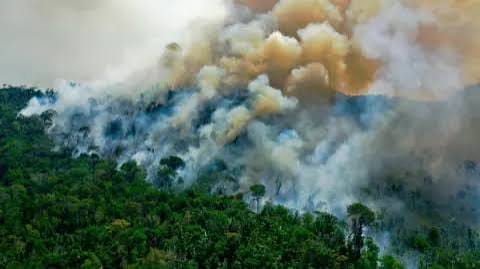
Ozone pollution generated by forest fires is weakening the Amazon rainforest’s ability to absorb carbon dioxide, adding to the damage caused by drought and deforestation, according to a new study that raises questions about similar risks to tropical forests in Africa.
The study, published in Communications Earth & Environment, found that ozone formed from fire emissions increases carbon losses from Amazon forests by an amount equivalent to about 24 percent of the carbon released directly by fires.
The findings reveal an indirect effect of forest fires that could undermine the rainforest’s role in absorbing carbon dioxide and regulating the global climate. They also highlight the need to investigate whether similar processes are affecting forests in Africa, particularly the Congo Basin, which plays an important role in storing carbon.
The Amazon is a major carbon sink, storing vast quantities of carbon in its vegetation and soils. But fires release carbon directly into the atmosphere while also producing nitrogen oxides that contribute to the formation of ground-level ozone, an air pollutant that damages vegetation and reduces photosynthesis.
Using a land-surface model to examine conditions between 1997 and 2024, the researchers assessed how fire activity, drought and changing atmospheric conditions affected ozone damage across the Amazon.
They estimated that the resulting reduction in the forest’s annual carbon uptake was, on average, 24 percent of direct fire carbon emissions. The estimated range was 18 to 35 percent, reflecting differences in how sensitive tropical tree species are to ozone.
The researchers cautioned that the figure is an order-of-magnitude estimate because uncertainties remain in how models represent ozone exposure, plant responses and other forest processes.
The damage was particularly pronounced during extreme droughts, when elevated fire activity increased ozone exposure across parts of the Amazon. In the southern Amazon, ozone-related losses of net primary productivity during August were equivalent to about half the losses caused directly by drought conditions.
Net primary productivity measures the carbon plants retain through photosynthesis after accounting for their own respiration.
The researchers found that fire activity was strongly associated with year-to-year changes in ozone pollution. Almost all fires in the Amazon are human-initiated, often linked to deforestation and agricultural land clearing, with flames sometimes spreading into neighbouring forests.
The 2024 drought stood out for its high fire activity and elevated ozone exposure in parts of the southern and southwestern Amazon. Although drought can reduce ozone uptake by forcing trees to close their leaf pores, known as stomata, the researchers found that intense fire activity could overwhelm this protective effect.
The findings are relevant to wider discussions about forest protection in Africa, where tropical forests face pressure from land clearing, agricultural burning and climate-related changes. The Congo Basin, which spans several Central African countries, is a major store of tropical forest carbon. However, the study did not examine African forests, and it does not establish that ozone pollution causes the same level of carbon loss there.
The researchers also found that rising atmospheric carbon dioxide concentrations and declining stomatal conductance had reduced ozone damage over the period examined. These effects, however, did not eliminate the risks associated with extreme fire seasons.
The authors called for efforts to reduce deforestation and forest fires, alongside improved long-term ozone monitoring across the Amazon. Better monitoring would help researchers assess the pollutant’s effects on vegetation and carbon storage.
For Africa, the research points to a question that requires further investigation: whether fire-derived ozone is also reducing the capacity of the Congo Basin and other tropical forests to absorb carbon. Understanding that potential impact could help improve estimates of forest carbon losses and inform strategies to protect these ecosystems.



Leave A Comment